Taking a step back from the short-term headlines that often dominate F1 news sites, here are some of the biggest news stories that have defined F1 in 2024. For this list I’ve looked at general trends across the year, rather than specific headline grabbing events. I’ve also prioritised things that seemed unlikely at the start of the year. (For example, there’s nothing about the rules of racing here, as it’s been debated and revised for several years now.)
- 1) Teams Are Struggling To Improve Their Cars
- 2) Alternative Models of F1 Teams Can Work
- 3) A Dynamic Driver Market
- 4) F1 Embraces Youth Again
- 5) F1 Is (Almost) A Closed Shop
- 6) Red Bull’s Power Struggle
1) Teams Are Struggling To Improve Their Cars
F1 teams have a wealth data available to them, from on track to wind tunnel to CFD simulations. And yet we’ve seen time after time this year that upgrades are not actually making the car faster. Or, at the very least, it takes a few months for this to be the case.
To start off, let’s look at a few quotes from teams this season
| team | quote |
|---|---|
| Mercedes | “There is still this behaviour of the car in a certain speed range that our sensors and simulations say this is where we should have the downforce and we are not having it” Toto Wolff |
| Racing Bulls | “It’s completely different behaviour to what I feel on the simulator” Yuki Tsunoda |
| Ferrari | “The upgrade brought us the numbers we were expecting, but it also brought us quite a lot of bouncing in the high-speed…. We decided it was probably better having a bit less performance but more consistency” Charles Leclerc |
| Aston Martin | “We added downforce in all the upgrades that we brought to the track, but we still cannot use all that downforce in an efficient way in lap time” Lance Stroll |
| Red Bull | “The simulator data did not match reality... ” Helmut Marko |
So what’s going on? The general conclusion is that teams are able to find an increase in downforce in the wind tunnel and simulators, but are failing to replicate this on track.
Top Team Experiences
Ferrari’s disastrous Spain upgrade is a good example. In this case, the drivers confirmed that the upgrade worked. However, it also introduced porpoising from running too close to the ground. The team could then either pick to run with porpoising and the inconsistencies that come with it, or raise the car and negate the performance the advantage they were looking for. Mercedes suffered similar issues early in the year. Whilst this was fairly typical of Mercedes in the ground effects era, Red Bull were facing problems for the first time. Whilst the handling and set-up issues initially appeared to be Perez-specific, it later affected Verstappen too. It’s not just the top performers that have had issues. Aston Martin recently reverted back to a floor from 7 months ago due to a lack of progress from upgraded parts.
Of course, the glaring exception in all of this is McLaren. Every upgrade has improved performance and worked as expected. Or has it? Their upgrade at Miami has made them the fastest team (on average) . Curiously, the team also seemed slightly bewildered as to why it was changing the handling of the car. However, in their case the upgrade actually improved things more than expected.
Why Are Upgrades Failing?
The issue is that these unexpected consequences are hard to predict without actually physically running the car. This, combined with limited testing, has made it incredibly difficult to get data from the car, wind tunnel and simulator to align. Christian Horner compared it to 3 watches all slightly out of time with each other. It’s interesting that whilst Mercedes’ early season struggles were entirely different to Red Bull’s the language used around correlation is of the same ilk.
The issues are partly caused by the specifics of the ground effect rules. It’s almost impossible to predict how low the car can run with just simulations and a wind tunnel. This, combined with teams pushing the boundaries of what is possible within the regulations, has left an uncertainty in how an upgrade will perform.
This means a lot of the analysis has to be done very visibly on track, so the teams only know how low they can run the car when they get there. It should be said though, that the teams have generally managed to get on top of their issues eventually. They’re just unable to do it without trackside data. This has made their struggles very public.
2) Alternative Models of F1 Teams Can Work
At the beginning of the hybrid era it seemed like you needed a manufacturer on board to be successful. This thinking was so baked in that it led to McLaren’s disastrous Honda partnership. Up until this season Red Bull were the only team to win multiple races as a customer team (with Renault). Even then, their engine relationship was seen as a major hindrance on their success, rather than a cause.
This year has been different. McLaren have won multiple races, and may well take the Constructor’s Championship too. The fact that they’re a customer team to Mercedes has barely been mentioned. Meanwhile, Renault are shutting down their engine department to voluntarily become a customer team. This would be unthinkable just a few seasons ago.
Finally the Haas team have been a revelation this year. Their 2022-2023 seasons had been very disappointing, and the assumption was they’d be at the back of the grid once again due to their limited resources. Indeed, even team principal Gunther Steiner believed that the team needed further investment. This opinion ultimately lead to him being sacked. But in the short-term at least they’ve shown it’s not necessary. The team are fighting the battle for 6th in the championship, and still have a good chance of coming out on top.
3) A Dynamic Driver Market
2024 was the first year in F1 history where there were no driver changes whatsoever in the off-season. There was also no obvious reason why much would change in 2025.
Then came the bombshell of Hamilton’s move to Ferrari. This move not only opened up a slot at a top team (Mercedes), but provided an opportunity many teams to try to court the now free agent Sainz, whilst he waited to see if a top team would sign him.
At the same time, the likes of Hülkenberg, Albon, Ocon, Gasly and Alonso were all free agents sniffing around for a potential upgrade. Whilst the market eventually settled (with Albon, Gasly and Alonso all staying put), it was an unexpected storyline throughout 2024. The majority of the teams will have at least 1 new driver for 2025, which was completely unexpected at the beginning of the year.
4) F1 Embraces Youth Again
One of the reason for the major driver reshuffle is the faith teams have put in rookie drivers. There are currently 4 drivers confirmed to start their first full season in F1 next year. A 5th of even 6th is a definite possibility depending on what Audi and Racing Bulls do with their lineups. This would be unprecedented in recent F1 history. Indeed, just a couple of years ago, rookie drivers were seen by many as either a risk or a liability.
Here’s a quick list of every rookies F1 driver from the 3 seasons of 2020-2022, along with their F1 results to date.
| Name | GPs STARTS | Wins | Podiums | Points |
|---|---|---|---|---|
| Pietro Fittipaldi | 2 | 0 | 0 | 0 |
| Jack Aitken | 1 | 0 | 0 | 0 |
| Nicholas Latifi | 61 | 0 | 0 | 9 |
| Nikita Mazepin | 21 | 0 | 0 | 0 |
| Mick Schumacher | 43 | 0 | 0 | 12 |
| Yuki Tsunoda | 84 | 0 | 0 | 89 |
| Nick de Vries | 11 | 0 | 0 | 2 |
| Zhou Guanyu | 65 | 0 | 0 | 12 |
Whilst their F1 careers has been varied, none of them managed to set the sport alight. Tsunoda has been far the most success, and has still had no poles, wins or even podiums. Of course we should always remember that even getting into F1 is extremely difficult, and staying there even more so. However, it’s fair to say that the results achieved by these 8 drivers as a group are not particularly impressive, even given the machinery at their disposal. Only 2 are on the current grid, with Zhou unlikely to remain there next year.
Why Gives Seats To Rookies Now?
The leap up to F1 is always difficult for rookies. This is especially true due to modern testing limitations. However, improvements to F1 simulators mean that Academy Drivers can still be experienced, even without proper F1 testing. Piastri showed that a strong debut season could be achieved in 2023, and this was backed up further by Lawson’s late season cameo and Bearman’s compelling cameo at the start of 2024.
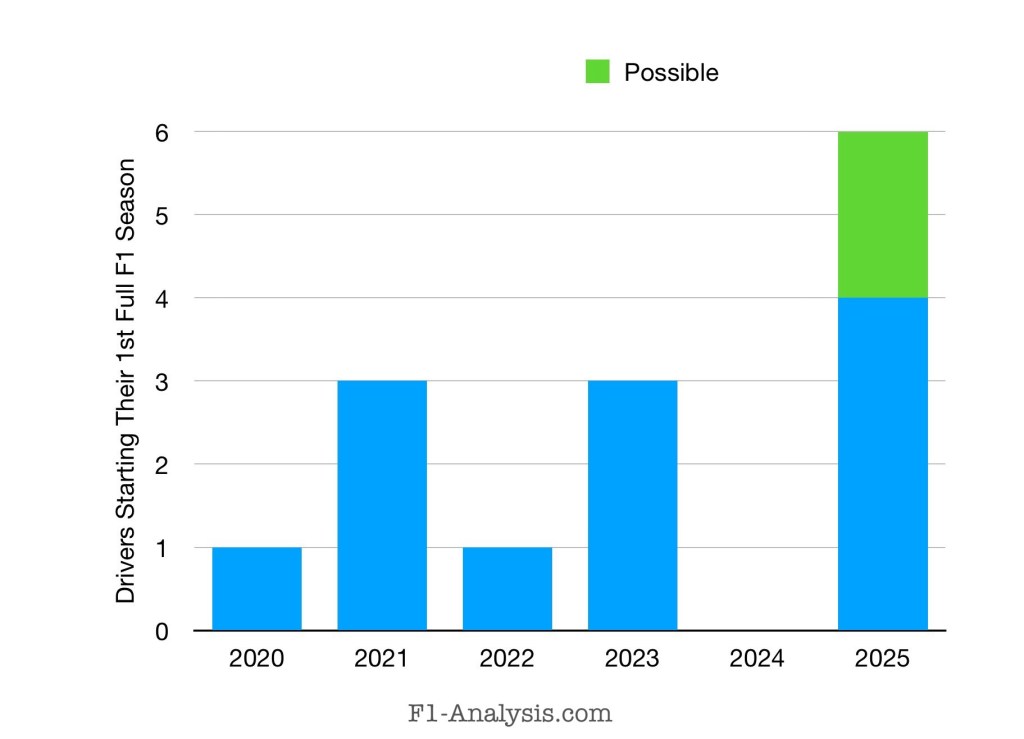
A secondary consideration is the results within F2. It used to be the case that the F2 winner was likely to get an opportunity in F1 (especially if they were inexperienced in the category). However, the current form in F2 is much harder to read, meaning teams are considering mitigating factors of their drivers.
Another potential explanation is that talent seems to come in waves. Button, Alonso, Räikkönnen and Montoya all debuted in either 2000 or 2001. Meanwhile 2006-2007 gave us Rosberg, Kubica, Hamilton and Vettel. Finally, Norris, Leclerc and Russell all between 2018-2019. It’s possible that we just happen to be in a very talented generation of young drivers, and teams are making the most of it.
5) F1 Is (Almost) A Closed Shop
One of the prevailing stories of the past 12 months is Andretti’s failing efforts to get itself onto the F1 grid. The reason this story has dragged on for so long is that it speaks to many different aspects of F1.
Firstly, it is unclear how a team can be allowed entry into F1. The sport is open to new applicants, but the bar is seemingly too high for even a highly credible outfit to be approved.
Secondly, it speaks to the power struggle within F1. The approval of Andretti by the FIA last year made their subsequent rejection a very public spat.
Thirdly, it’s a stress test of the priorities of F1 going forward. The addition of Andretti would potentially increase interest in America, add another manufacturer to the sport and provide a buffer should a team suddenly pull out. (Something that the sport should always be wary of. It currently has just 10 teams with support from Renault wavering.)
On the other hand, it may serve to dilute the financial rewards from the sport and irk the current teams. There’s also a worry that the team may not be competitive. (This was listed as the official reason for their rejection).
The final reason the story keeps resurfacing is the response from Andretti themselves. Rather than accept they’re not wanted, the team is still pushing forward with their wind tunnel and F1 preparations. They have also not gone the route of trying to win round doubters. Instead, they’re at loggerheads with the very people they need approval from, and have even got US lawmakers involved.
6) Red Bull’s Power Struggle
Red Bull have dominated the last few years of F1, and Verstappen is on his way to winning his 4th title. However it’s hard to shake the feeling that part of their structure is steadily imploding since the death of Dietrich Mateschitz.
In 2024 we’ve seen their competitive edge fade away and the most famous F1 car on the grid designer leave the team. The accusations Horner faced of inappropriate behaviour also did not help, nor did the fact that details were (seemingly) made public. The fact that Horner was cleared of the accusations is of some consultation, but the team has also been involved in a major power struggle between Christian Horner and Helmut Marko.

On the driver’s side Max Verstappen’s commitment to Red Bull seems less secure than at any point since he joined. Mercedes were publicly courting him earlier in the year, whilst father Jos’ comments warning of the team “falling apart” stirred things up further. Finally, the team have seemed paralysed this year over their choice of 2nd driver. Ricciardo was kept in Racing Bulls for almost the entire season despite not meeting expectations, whilst Pérez has been performing even worse in the senior team and yet still remains there.
So… Are Red Bull imploding?
Despite all of this, there’s little sign of that the team are actually imploding. Verstappen is still with the team, and looks likely to win his 4th championship in 4 years. Meanwhile, the public rows seem to have died down (for now).
Action has finally been taken to solidify their driver line up for 2025, with the replacement of Ricciardo at Racing Bulls. There’s also no indication that they want to leave the sport altogether, or even sell their 2nd team. So whilst there are definite cracks in the organisation, we are still yet to see major fractures that would truly pull them apart.
Finally, whilst they have lost some key people on the aero side, their engine development for the new regulations is still going full steam ahead. This also involved the poaching of several figures from other teams in 2021 for this very purpose. In short, their commitment to the sport is probably stronger than ever.
In all, the long-term potential of the team does look weaker than it has for several seasons. But doomsayers awaiting their imminent decline as a major team are probably wide of the mark.
Please Subscribe to find out when new articles drop!
Recent Articles:
 F1 Analysis