How did Schumacher win the 2006 Chinese Grand Prix? Schumacher’s final win demonstrated that his wet weather prowess had not diminished over time. Despite having the fastest car in the 2nd half of 2006, a number of factors worked against him in China. A wet qualifying session was a significant hindrance to Schumacher’s Bridgestone shod Ferrari. Meanwhile, title rival Alonso topped every qualifying session with teammate Fisichella alongside him on the front row. A further shower before the race made things harder still. So how did the fortunes reverse by the end of the Grand Prix to allow for an unlikely comeback?
- Bridgestone vs Michelin
- The 1st Phase: Advantage Michelin
- How fast was Schumacher?
- Alonso’s pace deteriorates
- Renault Leave Alonso To Fight
- Alonso In The Pits
- Schumacher’s Incredible Outlap
- Conclusions from the 2006 Chinese Grand Prix
Bridgestone vs Michelin
In 2006 the field was fairly split between Bridgestone and Michelin tyres. Whilst the previous trend of Ferrari being the only truly competitive Bridgestone runner was retained, there were semi-competitive Bridgestone teams such as Williams and Toyota.
In the wet Michelin typically had an edge in ideal conditions for intermediate tyres. However, the Bridgestone intermediate had a good working range, and were at least as competitive on semi-dry tracks. Schumacher’s Ferrari ran Bridgestones, whilst title rival Alonso’s Renault ran Michelin.
Qualifying was wet (favouring Michelin), whilst the race also started wet before gradually drying out.
2006 Chinese Grand Prix Race Qualifying: Schumacher pulls a rabbit out of the hat
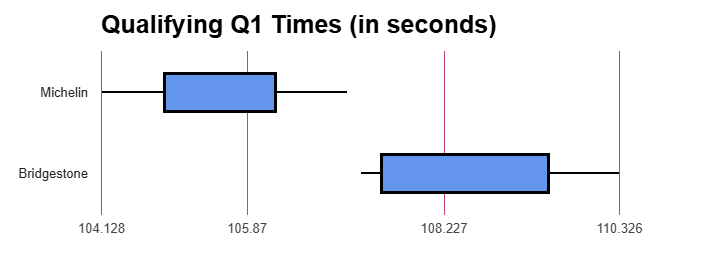
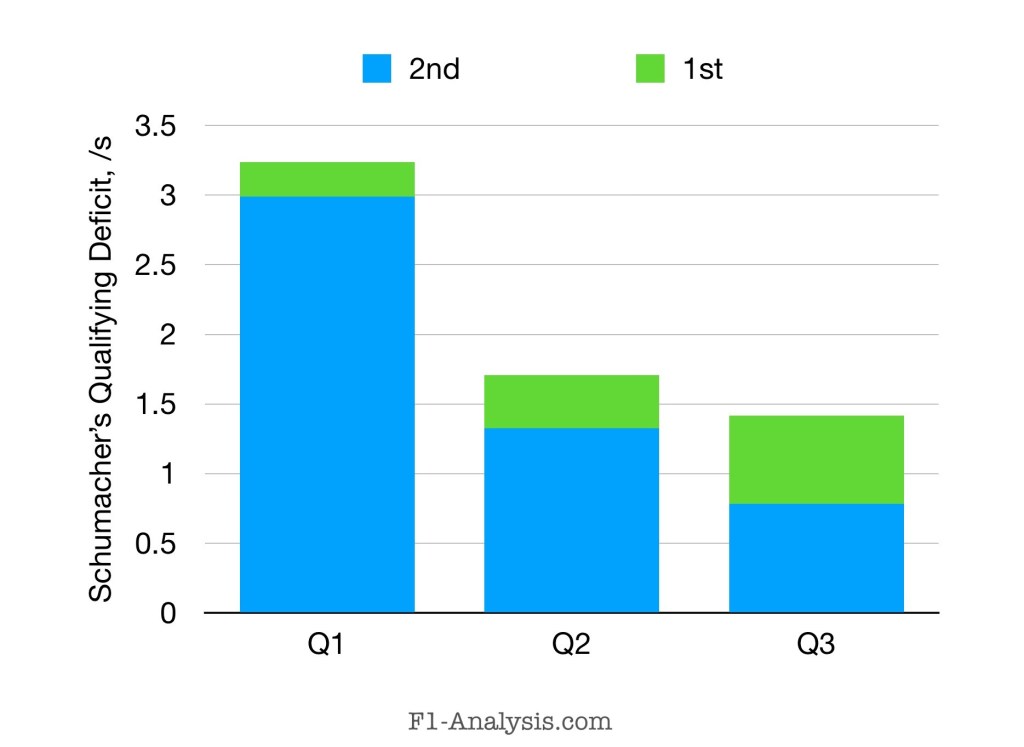
The wet qualifying session in China heavily favoured the Michelin runners. In Q1, the tyres were the defining factor, with an average gap of 2.5s between the Michelin and Bridgestone runners. Schumacher was only able to make it out of Q1 by way of beating other Bridgestone runners.
By Q2 the track had slowly come to the Bridgestone runners, with most of those remaining in Q2 finding major gains. Schumacher’s lap was a full 1.7s faster. He was the only Bridegstone runner to make Q3, sneaking in by a couple of tenths. For Q3 he produced a masterful lap putting him 6th on the grid. The lap would prove to be even better in hindsight; he was fueled significantly longer than Button, Barrichello and Räikkönen ahead of him.
From this position, a podium seemed likely, but Alonso was still the obvious favourite for the race. He’d topped every qualifying session, was fueled longer and had teammate Fisichella alongside him on the front row. (Schumacher’s teammate Massa qualified 13th before receiving a further engine penalty.) Worst of all, a heavy shower just before the start of the race gave the Michelin runners an early advantage on Sunday too.
The 2006 Chinese Grand Prix Race
The 1st Phase: Advantage Michelin
Alonso aced the start and duly pulled away from the rest of the field. Schumacher was surrounded by Michelin runners and successfully focused on maintaining position in the first few laps as the cars began to make a drier racing line.
With no further rain, the advantage from the Michelin tyres reduced lap after lap. Soon Schumacher closed on the Hondas in front, passing Barrichello on the 8th lap. Unfortunately he’d already lost over 20s to Alonso at this point. However, a further pass on Button allowed him to begin clawing down Fisichella’s Renault ahead.
How fast was Schumacher?
Whilst he’d lost out massively to Alonso, perhaps a simpler comparison in this phase is to other Bridgestone runners. After 8 laps he was 20s ahead of every other car on Bridgestones, and a full minute ahead of most by lap 20. For context, the 2nd best Bridgestone runner during this opening phase was Webber, who was also having a strong race. (Webber gained 7 places in the first 20 laps.)
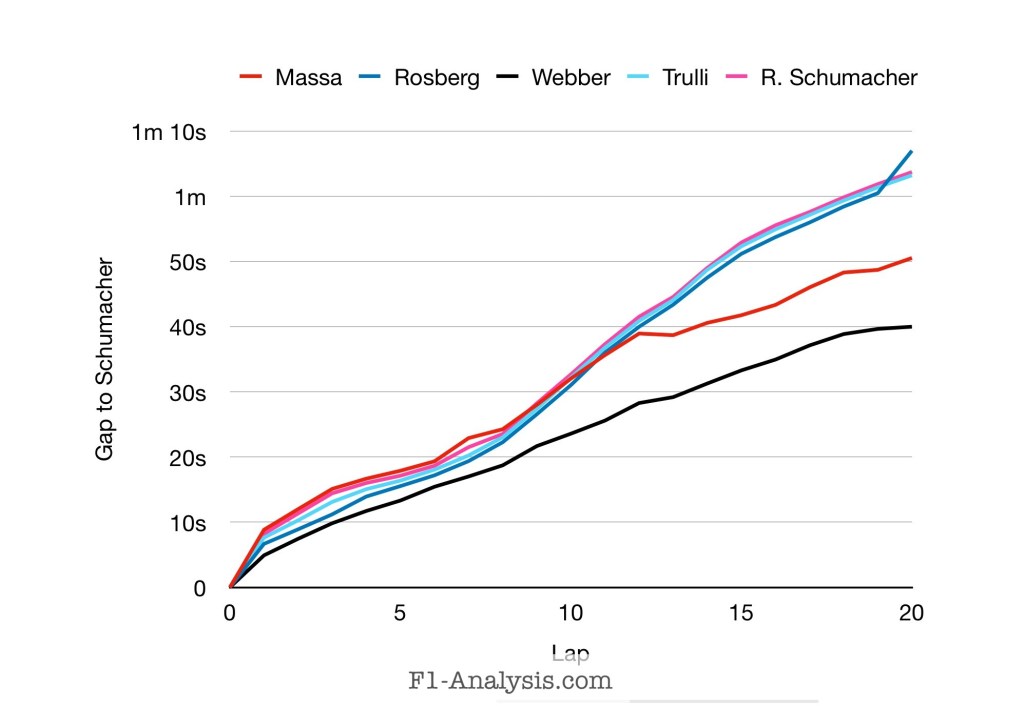
Some of this gap is be expected, given natural field spread and the fact that Schumacher’s car was fundamentally faster than the other Bridgestone runners (except teammate Massa). Still, it highlights how well Schumacher was performing in this tricky early phase.
Alonso’s pace deteriorates
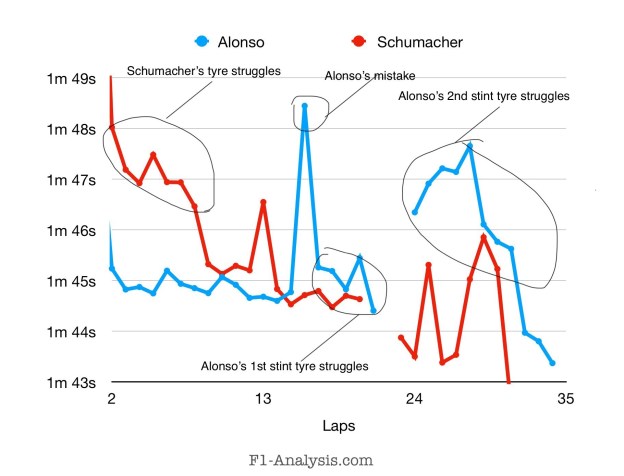
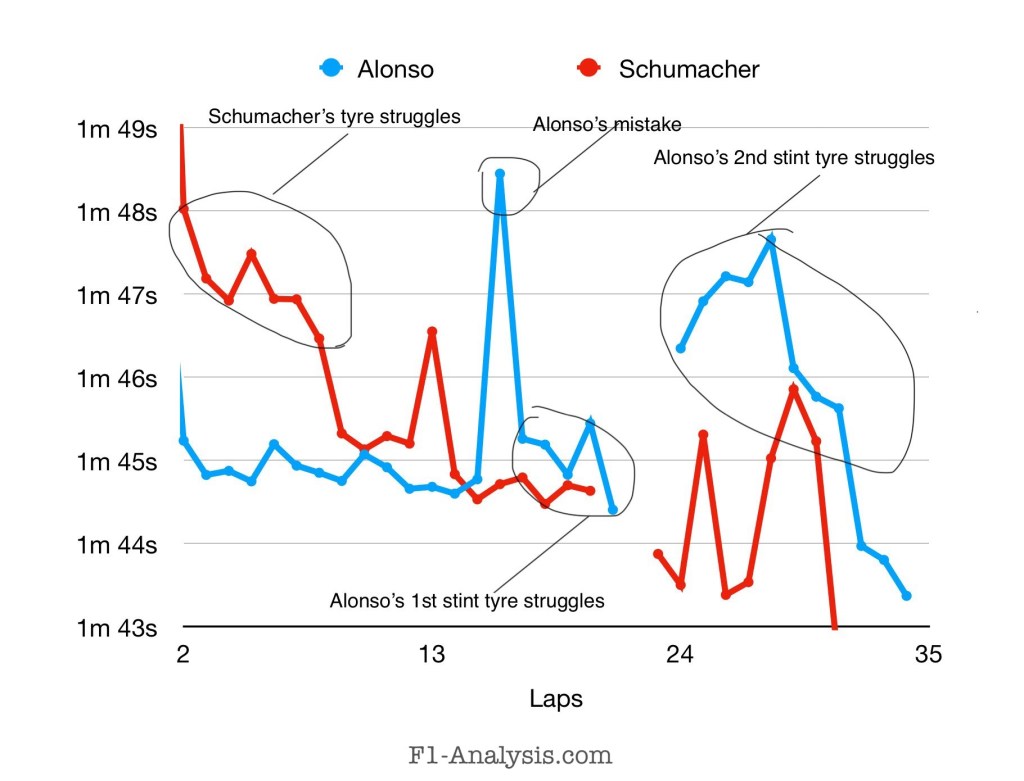
On lap 13 Räikkönen passed Fisichella for 2nd place and very gradually began to catch Alonso for the lead. A couple of laps later 16 Alonso made a mistake, and soon reported damage to his front tyres. His pace slowed by around a second a lap, and Fisichella and Schumacher also began to catch Alonso. Räikkönen pitted early only to retire a few laps later, meaning the race was now a straight fight between Renault and Ferrari.
In most circumstances Alonso’s tyre struggles would not be a major issue. The 1st pitstop was approaching, and so there was an opportunity to change tyres and keep a healthy lead. However, the track was gradually drying, and it was fairly standard practice at the time to intermediate tyres on. The wear on the tyre would gradually turn it into a “slick” that would outperform a new intermediate and allow for a larger crossover range onto a proper dry tyre. And so Renault had a dilemma. It was too wet for dry tyres, so should they give Alonso new intermediate tyres or keep him on his current set that he was struggling with?
In the end they chose a compromise: to change his front tyres and leave the rears. This move was wildly criticised for creating balance issues and hampering Alonso’s second stint. The data shows that it was a mistake: Alonso was losing around half a second a lap to Schumacher and Fisichella before the pitstop. After it, this ballooned to around 3s a lap. Whilst Alonso’s pace did improve throughout the stint, he was still lapping 1.5s off Schumacher’s pace by the time he switched to dry tyres.
Renault Leave Alonso To Fight
In the 2nd stint Fisichella and Schumacher caught Alonso relatively easily. At this point Renault allowed Fisichella to fight and overtake Alonso, with Schumacher following through shortly afterwards. This was another mistake from Renault. It would have been far more logical to order Fisichella to hold station. After all, Alonso’s tyre issues were temporary, and protecting his championship lead was surely the priority.
Schumacher continued to stalk Fisichella, but pulled out 8s on Alonso in just 4 laps, before the Spaniard abandoned his tyres for a set of slicks. Alonso later said he felt “alone” and did not get enough support from the team at this moment. (He would echo these statements more strongly a year later at McLaren.) It’s hard not to feel that his statement was justified. Fisichella spent around half the entire race with Schumacher on his tail, so it’s quite conceivable he could have done this while sticking to Alonso’s pace. Had Alonso maintained the lead (even for just a couple of laps) it would have made his chance of victory much higher. Had he maintained the lead for longer he could even have chosen to switch to slicks later, saving him even more time.
Alonso In The Pits
As it was, Alonso pitted relatively early for slicks to get rid of his problematic intermediates. However, things went from bad to worse for him as his pit stop was around 11s longer than expected due to an issue with the right rear tyre. This put him completely out of contention. This was compounded by the time taken to warm up the slick tyre on a damp track, meaning he list further ground to Schumacher and Fisichella ahead.
However, Alonso’s outlap was competitive (given the damp conditions) and he soon returned to the meteoric pace he’d displayed in the first third of the Grand Prix. Unfortunately it was a little too late.
Schumacher’s Incredible Outlap
With Schumacher shadowing Fisichella the track continued to dry, it became apparent that the slick tyres were fundamentally faster. However, the fact that it took 2 full laps for the slicks to reach their operating temperature meant both lead drivers were cautious of making a stop too early.
Eventually, Schumacher went for slicks the lap before Fisichella. Given this, and the fact that Fisichella gained a full second on Schumacher in the pitlane, it seems logical that Schumacher would emerge behind. This is indeed what happened, but Schumacher was close enough to pounce on Fisichella at turn 1 whilst the Renault driver’s tyre were still cold.
How was Schumacher close enough to do this given the aforementioned warm up issues? The answer is that he managed to heat up his tyres quickly. His, outlap was mesmerising, and far faster than any other driver. Just look at the record of outlaps on slicks tyres in the race:
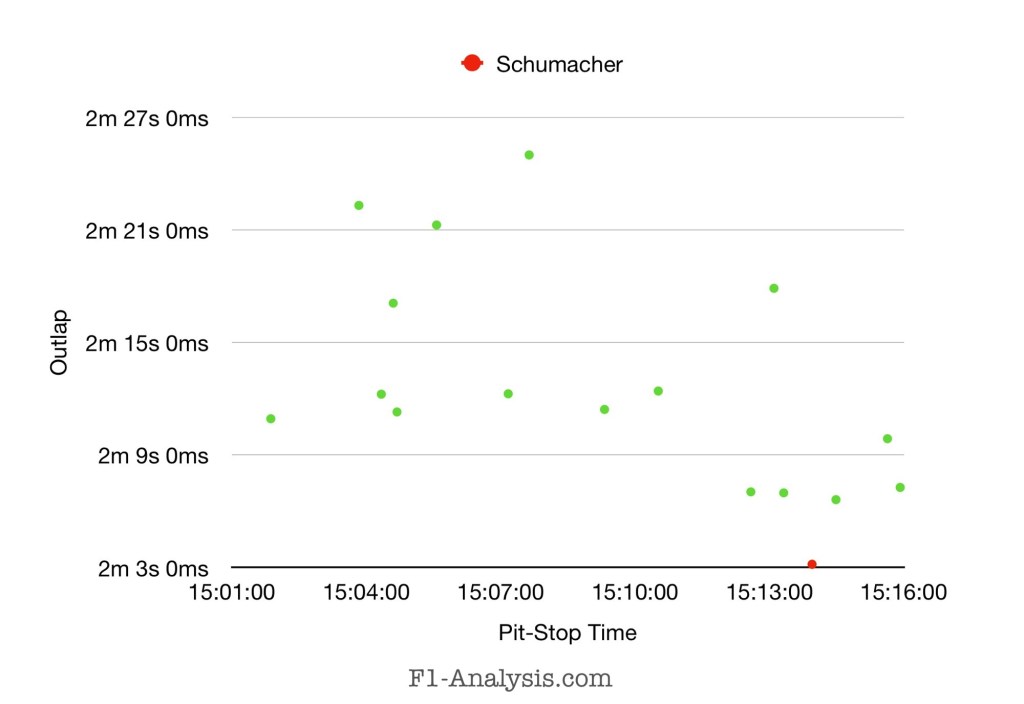
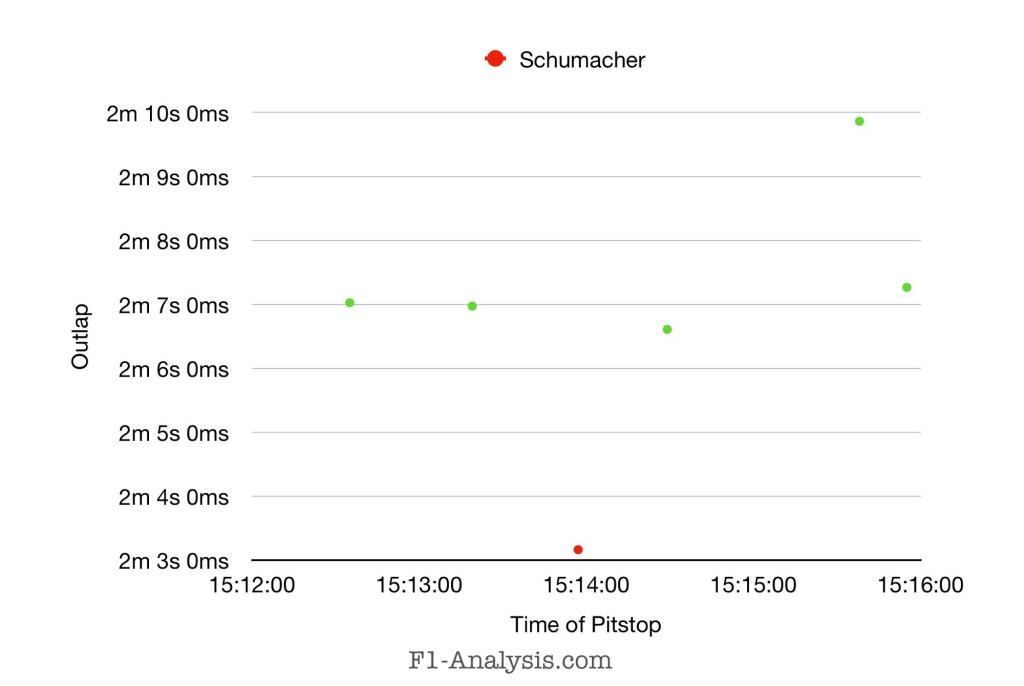
(Local times are used for the pit-stop, as opposed to laps as the field is quite spread out by this point.)
Schumacher’s lap was around 7s faster than those that had a successful outlap a few laps before (other drivers were far slower due to going off). Of those that pitted around the same time as him, Schumacher was around 4s faster (and crucially almost 7s faster than Fisichella, who pitted after him).
Conclusions from the 2006 Chinese Grand Prix
From then on the race was fairly routine for Schumacher. However, there was one final twist. At this point Alonso was around 24s behind Schumacher with his slick tyres fully up to temperature. With just 15 laps left, he began gaining on Schumacher hand over fist. Whilst it wasn’t enough, Alonso was just 3s behind at the flag. It was a remarkable recovery given his tyre issues, strategy blunders and a slow pitstop to boot. In hindsight it definitely feels like Renault threw the race away.
Having said that, Schumacher was able to overcome the disadvantage of a wet start and beat both Renaults. It was a stellar performance. By the end of the race he was well over a minute clear of every non-Renault driver.
The race gave Schumacher the championship lead with 2 rounds to go. Ultimately, the end of the season did not go Schumacher’s way, and despite having the fastest car for most of the season the championship eluded him. That doesn’t mean that his final Ferrari season was a disappointment though. He proved in China that he and Ferrari could still win races against the odds and deliver at a level that few have managed before or since.
Recent Posts:
 F1 Analysis