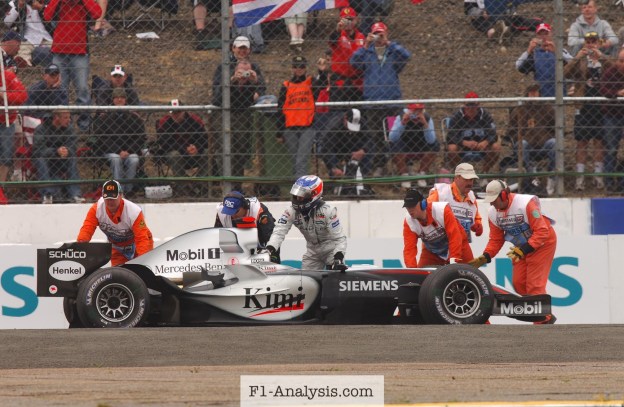
Why did it take McLaren 25 to win the Constructor’s Title since their success in 1998? During this period the team has had some dry spells, but also enjoyed much success, with 60 Grand Prix wins and 2 Driver’s Championships. They’ve also regularly had some of the strongest driver line-ups. (These include Räikkönen-Montoya, Hamilton-Alonso, Hamilton-Button and Alonso-Button.) These drivers have lead them into at least eight credible fights for the Constructor’s Championship. In all of them the team have fallen short.
Here we look at the history of the team and reasons why it took to long to come together.
- 1998: McLaren’s Last Constructor’s Title For 25 Years
- 1999: Fast But Fragile
- 2000: Battle with Ferrari
- 2003: Consistent But Not Enough Wins
- 2005: Fast But Fragile… Again
- 2007: Spygate
- 2008: Another Driver’s Title
- 2010: Hamilton and Button make the best of things
- 2012: A Lost Opportunity
- Subsequent Years
1998: McLaren’s Last Constructor’s Title For 25 Years
McLaren had a dream start to the 1998 season. Their exclusive engine partner Mercedes had finally achieved both power and reliability. Häkkinen and Coulthard were two hungry, fast drivers. Their choice of Bridgestone tyres appeared to the right one. And best of all, their new signing Adrian Newey had nailed the new regulations for the season and produced the best car. The future seemed bright
The team dominated the first two races, almost lapping the entire grid both times. A typically spirited comeback from Schumacher, Ferrari and Goodyear made the championships much harder than they should have been. However, the team secured both titles at the final race, and looked to have a very strong future ahead. Unfortunately, their first major fumble came next year in 1999.
1999: Fast But Fragile
This season was a major missed opportunity for the team. They clearly had the best car, with Häkkinen has taken all but 5 poles. Indeed, if the Constructor’s been based just on qualifying, McLaren would have almost doubled Ferrari’s total (203 – 103). Häkkinen also took the Driver’s title, so what went wrong with the Constructor’s?
Their first issue struck right away: reliability. Both cars failed to finish to season opener, and Coulthard recorded mechanical failures in over a third of the races. Driver errors also added up, with Häkkinen throwing away crucial victories in Imola and Italy.

Ultimately, the Constructor’s was decided by the smallest of margins. With two races to go McLaren were still leading. However, three things tipped the Constructor’s title in Ferrari’s favour. Firstly, Schumacher returned from injury after missing several races. Secondly, the Ferrari car had a late season rivival. These two factors combined meant that the team were able to overhaul McLaren with 4 podiums in the final 2 races (including a win in Malaysia).
That leaves one other factor: A precise measurement of Ferrari’s bargeboards. At Schumacher’s comeback race in Malaysia Ferrari recorded a 1-2 finish, only to be disqualified for a technical infringement. Ferrari accepted guilt and both championships were (informally) declared in McLaren’s favour with a race to space. However, Ferrari subsequently protested the result, and after demonstrating that their barge boards could be within the tolerance allowed within the rules if measured in a very specific way. This made all the difference, and the title went to Ferrari by just 4 points (128-124).
Ultimately though, far more points were lost due to DNFs, and their inconsistency cost them dearly.
Conclusion: Had the speed but not the reliability.
2000: Battle with Ferrari
By the 2000 season Ferrari had properly caught up to McLaren. A titanic battle for both titles ensued. McLaren scored no points in the first 2 rounds. However, Ferrari’s early lead was overhauled in the midseason, as the McLaren’s early reliability issues were resolved. The silver cars were again leading the championship going into the final few races. Ultimately Schumacher ended the season with 4 wins from pole, which was enough to overhaul McLaren.
Other than the early reliability gremlins, McLaren also lost 10 points in the Constructor’s championship (although curiously not the Driver’s championship) due to a missing seal in the Austrian Grand Prix. Coulthard was also disqualified from the 2nd race in Brazil. Whilst, there was improved reliability and fewer driver mistakes this season, these little issues added up in such a close fight.
Conclusion: Not quite as fast as Ferrari at the start and end of the year.
2003: Consistent But Not Enough Wins
The initial outlook for McLaren in 2003 did not look strong. The team had spent 2002 in the doldrums and, like Ferrari, they decided to start the season with an updated old car. Unlike Ferrari, McLaren’s new car never materialised due to its woeful reliability .
Surprisingly, the team were sitting 1-2 in the Driver’s championship after 3 races, with a healthy 23 points lead over eventual champions Ferrari in the Constructor’s. However, all three races had been slightly unusual, and when Ferrari launched their new car at Imola Schumacher took 3 poles and 3 wins in a row. From then on the season ebbed and flowed between Ferrari and Williams having the fastest car. However, McLaren were never out of the count, with Räikkönen in particular a consistent podium finisher. The team were also aided by the new points system that favoured consistency over wins.

With 3 races to go McLaren were very much in contention, just 6 points behind eventual champions Ferrari. However, it was at this point that a controversial ruling on tyres was issued. This negatively impacted both McLaren and Williams’ Michelin tyres without affecting Ferrari, who used Bridgestone tyres. Ferrari won the last 3 races, and McLaren were left 16 points adrift of success in 3rd place.
Conclusion: Lacking raw pace and victim of a controversial ruling
2005: Fast But Fragile… Again
2005 was the last season that McLaren unambiguously had the fastest car. Räikkönen and Montoya also made a formidable driver pairing on paper. However an awful start to the season saw them playing catch up after the first 4 races. From then McLaren were the top scoring team, but they were hampered by regular grid penalties and reliability issues.

The team also failed to get the best out of Montoya. The Colombian missed two races in suspicious circumstances. There were also multiple costly mistakes including a disqualification in Canada for running a red light, a lapse in concentration in Turkey that let Alonso through and an early race crash in Japan. The non-start for all Michelin runners in the infamous US GP also lost the team an opportunity to close the gap.
Despite all of this, the team lost out by a mere 9 points. With improved reliability it would have been an easy win, even discarding all the other issues at hand.
Conclusion: A lightning fast car upended by a poor season start, unreliability and some poor performances.
2007: Spygate
In 2007 McLaren seemingly had it all. A car fast enough to win. One of the strongest driver line-ups of all time (Hamilton-Alonso). And near perfect reliability. Title rivals Ferrari also suffered some inexcusable mistakes, such as forgetting Massa’s car needed fuel in Hungry qualifying and starting the cars on illegal tyres in Japan. Despite all of this, both titles escaped them again.
As story of spygate has been discussed ad infinum, I won’t repeat the details here. The important point is that McLaren were excluded from the Constructor’s Championship for obtaining data on title rivals Ferrari. They were also given the largest fine in sporting history.
Simply adding together the McLaren driver’s points gives them the championship, but this also ignored the fact they were due to have their points from Hungary taken away from them anyway due to Hamilton and Alonso’s teammate rivalry (and Alonso’s unhappiness with the team) boiling over in a very public way.
McLaren’s use of Ferrari data, in addition to their mishandling of Alonso’s relationship with the team, cost them both titles in 2007. It also probably cost them the Constructor’s in 2008, given that Alonso’s replacement was generally unable to keep pace with Hamilton.
Conclusion: Spygate was extremely costly (in more ways than one)
2008: Another Driver’s Title
As with 1999, this was a season that saw a McLaren driver take the driver’s title but the team lose out on the Constructor’s. As with 2007, the team probably didn’t have the best car overall. Again, title rivals Ferrari made some high profile errors (including the infamous 2008 Singapore Grand Prix) and had worse reliability. McLaren’s lack of ability to consistently get the best out of Heikki Kovalainen ultimately cost them points. The Finn scored just 3 podiums all year despite some strong races.
Conclusion: Worse car than Ferrari and inconsistent 2nd driver
2010: Hamilton and Button make the best of things
Whilst the team had a strong driver lineup (Hamilton-Button) and good reliability, it never had the outright speed of the Red Bull. With just 1 pole position all season, it’s perhaps surprising that they were in the hunt at all. However, they secured 5 opportunistic wins and held a lead in the championship of 30 points at the half way point in the season. Four retirements in as many races saw them easily overhauled in the last third of the season, but the reality is that the Red Bull was just faster.

Conclusion: Made the most of what they had, but lacked outright pace.
2012: A Lost Opportunity
This season is remembered for the classic title battle between Vettel and Alonso. However, McLaren were also in the mix most of the time. In fact, Hamilton was the top qualifier of the year. However, the team suffered more DNFs than title rivals Red Bull and Ferrari combined. In addition, pit stop errors led to a large number of lost points. These included Hamilton being stripped from pole in Spain (due to insufficient fuel), As in 2024, the team failed to make the most of their opportunities.
Conclusion: A fast car with many missed opportunities.
Subsequent Years
Little did McLaren know that 2012 would be their last chance at a title in over a decade. At the end of 2012 Hamilton left for Mercedes. The team also suffered from poor chassis and the fact that they became a customer engine team starting in 2010. The desire to avoid this problem long term then led to something even worse: their disastrous partnership with Honda. Not only did the poor engine performance and reliability hinder results, but it also masked the fact that the car itself was mediocre in the mid-late 2010s.

The road to recovery was long with McLaren, with just 1 win in over a decade between 2013 and 2023. After a restructure and a return to Mercedes engines, the team finally succeeded in 2024.
Thanks for reading, please subscribe for new articles to be sent to your inbox!
 F1 Analysis