Who’s the greatest F1 driver of each era? By using a mathematical model to only compare results between drivers with the same car, I have previously attempted to answer this question. Below is an updated analysis, with an improved model and almost 3 seasons worth of extra data.
- How Does The Model Work?
- Updates since last time:
- The Best F1 Performance Of All Time
- Results Of Each Season
- The Best F1 Drivers Each Year
- Drivers With The Most “Top Performances”
- Summary of Eras
- Performances of Driver’s Champions
How Does The Model Work?
The model compares the race results that drivers achieved against their teammates. This gives a relative rating of teammates for each season. It then compares different seasons (and different teammate match ups) to rate F1 drivers relative to each other. Almost every driver in each F1 season can obtain a rating through this method. Along with race finishes, the model also takes into account the age decline and inexperience of drivers when evaluating their strength compared to other seasons. See here for more a more detailed breakdown of the model and how the scoring rating works.
Updates since last time:
The major updates to the model since the last major post on the history of F1 are below:
- The inclusion of the 2022, 2023 and (most of) 2024 seasons.
- Mechanical DNFs: A DNF that’s due to car/team failure is recorded as such. In effect, this changes the input from “points per race entered” to “points per race entered with no DNF caused by car failures”.
- Driver error DNFs: DNFs due to driver error will lower that driver’s rating for the season. The inclusion also means that the teammate of the driver who crashed will see their rating will increase less than was previously the case. This is because scoring highly vs a teammate is less impressive if it is due to the teammate consistently crashing.
In general, these changes do not make vast differences to the results. However, there are some notable changes within seasons due to the effects of unreliability. Driver performances are generally a little less “spikey” across seasons (i.e. performances are considered a little more consistent year-to-year). There are also a few changes in the highest rated driver, which are discussed later in the article.
Changes to the Strength of Top Drivers
Most of the previously top rated drivers of their era are still considered so. However, Moss and Stewart are now a little stronger relative to their competition. Both are considered to be clearly the strongest driver on the grid for an extended period of time. (Previously, Moss was only considered to be probably the best post-Fangio driver. Stewart was one of several top drivers of his era.)
Meanwhile, Lauda and Prost have gone from the best of their era to facing some stiff competition (from Hunt and Senna respectively). Schumacher was already the best of his era, and is now considered slightly stronger in the early 90s. However, his performance during his Mercedes comeback in the 2010s is slightly weaker. (His comeback is still considered to be more than competent though.)
Finally, the addition of the 2022-2023 seasons (plus the start of 2024) have adjusted the ratings of some more recent drivers. In particular, the ratings of Norris and Sainz and now a little higher.
The Best F1 Performance Of All Time
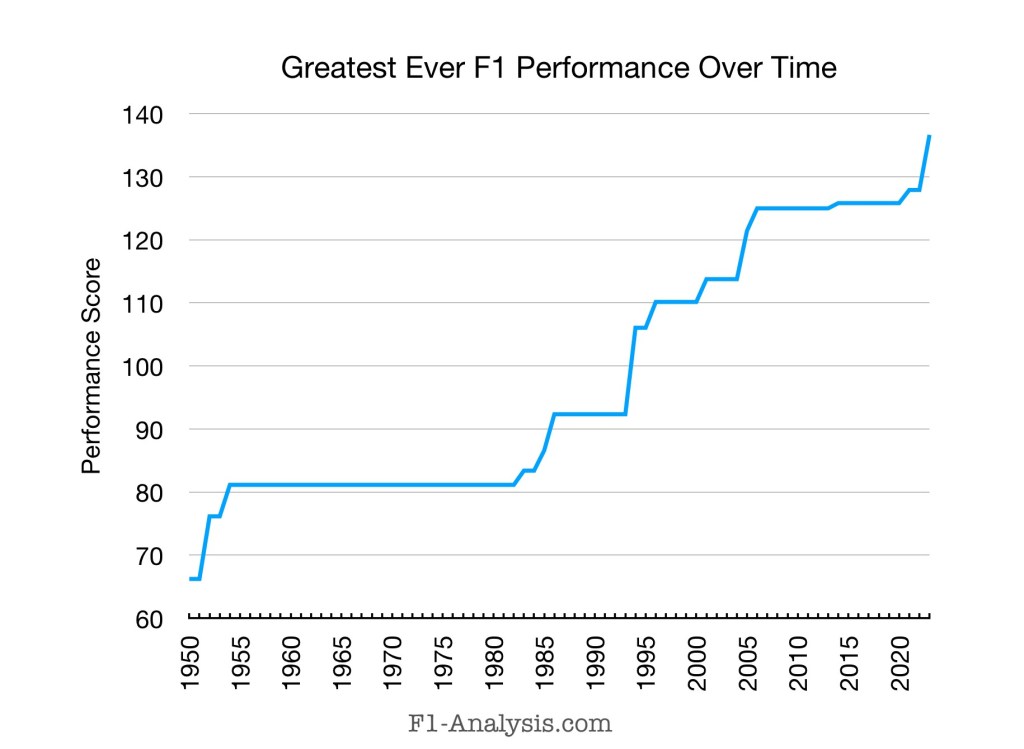
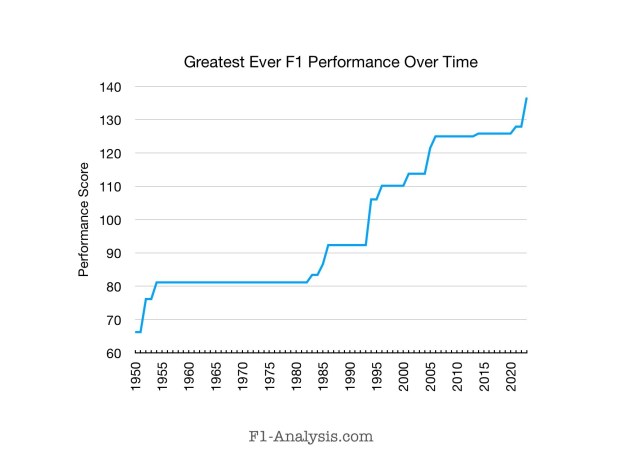
As previously discussed, the model believes that F1 drivers are getting stronger over time. This is true for the best drivers of the era, as well as “average” drivers of the era. Even the worst drivers on the grid show a general upward trend over time.
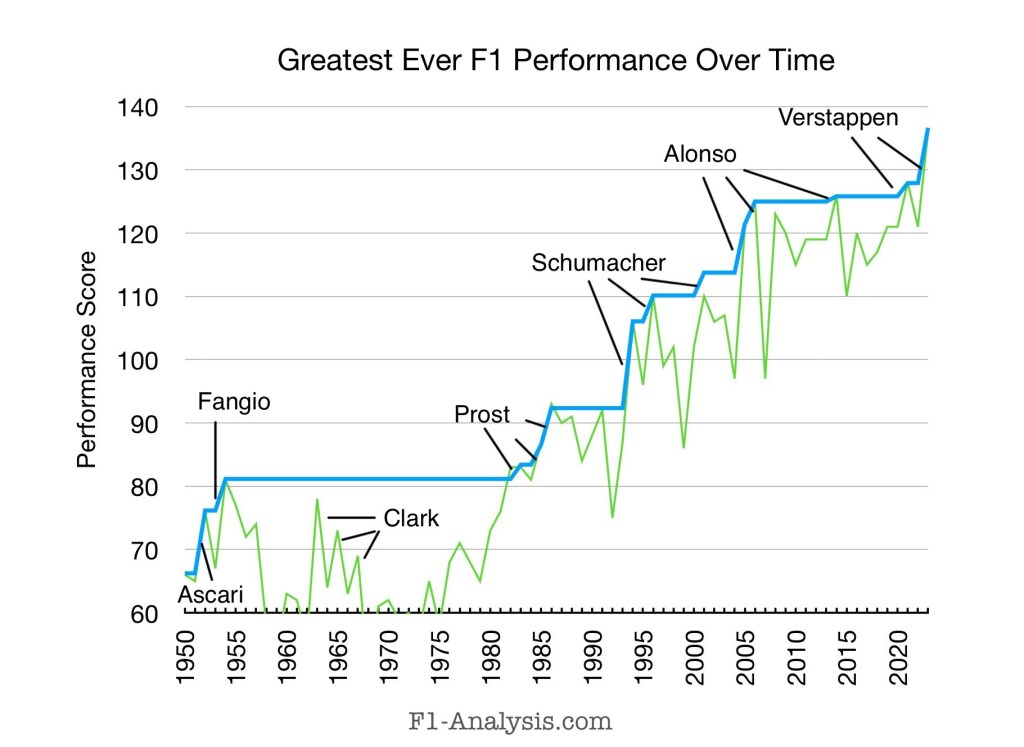
Across the history of F1, there are a total of 6 drivers who have set a new bar for the highest rated season ever. These are Fangio, Ascari, Prost, Schumacher, Alonso and Verstappen. This does not necessarily mean that these are the absolute top drivers relative to the era they raced in. (Senna and Prost are very closely ranked, for example.)
Below I have also included the highest rating for each season, as well as guides for the aforementioned drivers. I have also highlighted Clark. This is because he has the unique distinction of being ranked higher than both drivers directly before and after him.
Results Of Each Season
I have split the history of F1 into eras below. These roughly correspond to periods where a driver is dominant, or the top drivers are similar.
1950-1957
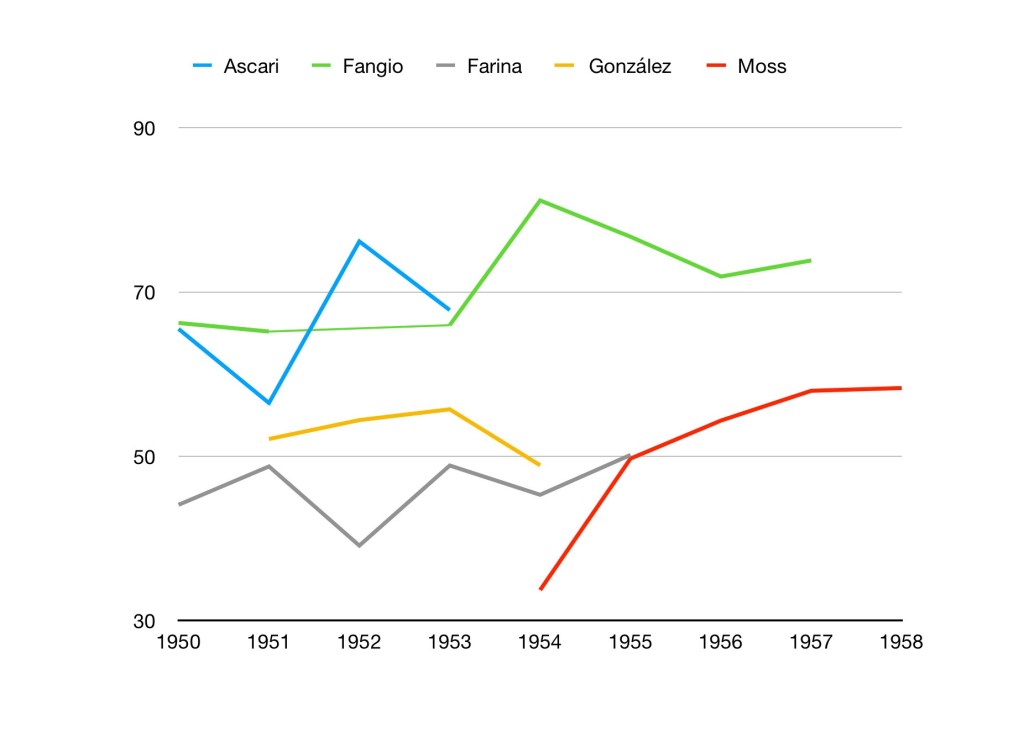
Fangio won every race he finished in 1950, so it’s no surprise to see him ranked the best driver. By comparison, the older model gave Fangio a worse rating for 1950 than Ascari, due to DNFs. Fangio is ranked as the top driver in every year he competed with the exception of 1953.
His performance in 1954 is in particular considered to be exceptional. This was when he switched teams mid-season. His season was near-perfect and he easily outperformed all 7 teammates he had. It takes nearly 30 years for another driver’s season to be rated as highly as Fangio’s in 1954. This is all the more remarkable given Fangio was well into his 40s at the time.
Ascari‘s short career yielded much success, and the model has concluded he is (almost) Fangio’s equal. His championships in 1952-53 were well deserved despite an obvious car advantage and the fact that Fangio did not race in 1952. Previously Fangio had the highest driver rating in 1953, but his rating this time is slightly lower (relatively) due to his teammates suffering worse reliability than him across the year.
Moss emerged as the best driver on the grid once Fangio retired, although once again the model has concluded he’s not quite on the level of Fangio. Gonzalez and Farina are both thought of as competitive and close to Moss’ level, although their careers did not overlap much with Moss.
Relative Ratings of 50s Drivers
The model concludes that both Ascari and Fangio’s ratings would be considered respectable today, equivalent to a solid midfield driver like Albon or Hulkenberg. (Although such a direct comparison may not make much sense given the vast changes in the sport.) However, the model considers the improvement of drivers in modern F1 to be slightly faster than previously. This means that their rating relative to the current grid has actually decreased slightly.
1958-1961
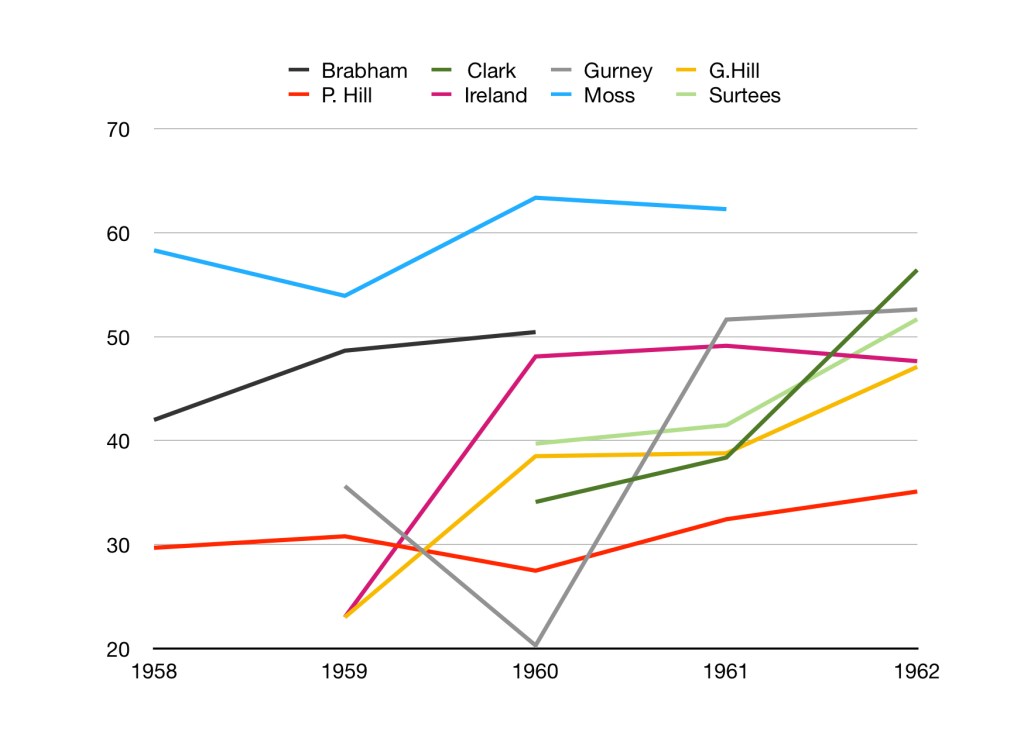
The best rated driver in the late 50s – early 60s is clearly Moss. Drivers such as Brabham and Ireland provide the closest competition behind. Hawthorn is also worth mentioning, as the 1958 world champion was 2nd highest ranked driver that year.
Meanwhile, Phil Hill is the worst ranked champion, both in absolute terms and relative to the grid as a whole. The model considers the grid around this time to be the weakest it’s ever been. Despite this, he’s ranked as the 13th best driver of 1961, and owes much of his success to his dominant Ferrari car.
As the 1960s begin, we see a spew of closely matched drivers emerge. Of these, it was Jim Clark that came to dominate the following years, both in terms of results and in the model’s eyes.
1962-1967
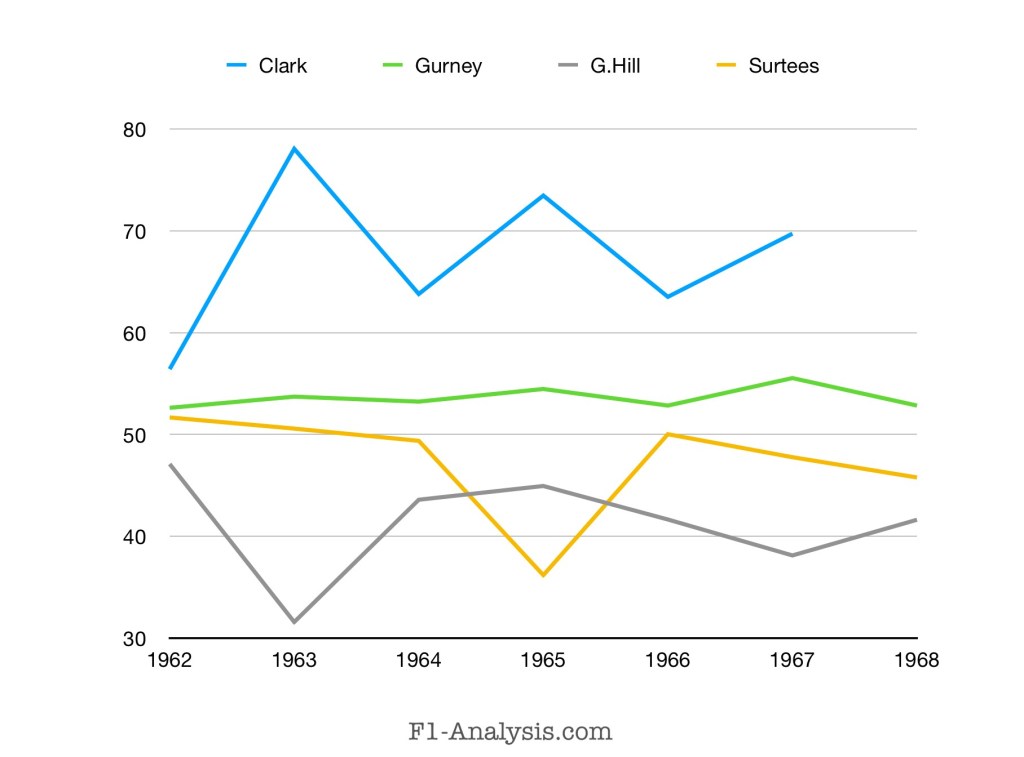
Whilst Gurney, Surtees and Hill were unable to progress further, Clark found a new level and dominated the 1960s. Some of his statistics are unthinkable today. In 1963 he ended the season with a perfect score (he won 7 races, with each driver’s top 6 results counting towards the championship. His teammates scored just a single point between them.
Clark is also the highest ranked driver 6 years in a row. Only 2 drivers have more than this (Alonso and Schumacher). He is also one of only 2 drivers (along with Fangio) that’s considered to be fundamentally better than those that followed. His ranking is similar to that of Fangio and Ascari and well above everyone he raced against.
Dan Gurney is rated the second best driver of the era, with Surtees and Graham Hill also rated comparatively well.
1968-1972
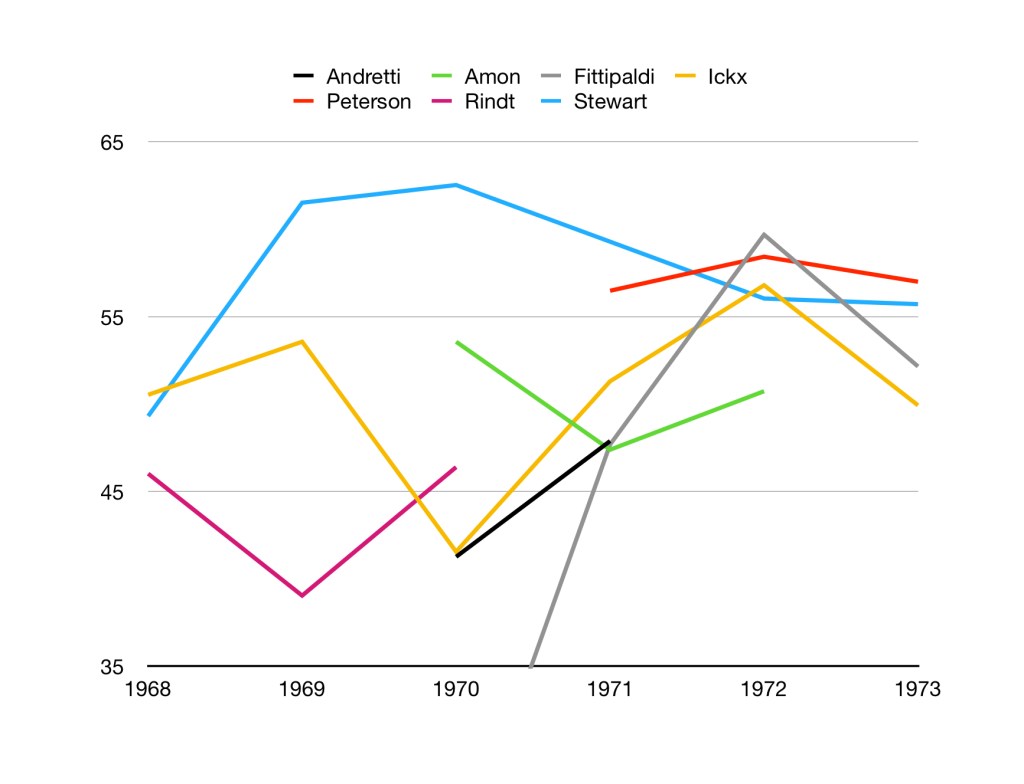
Stewart has been given a boost relative to the previous model’s ratings. He’s now considered to be the best driver for 3 consecutive years, and easily the best driver in the post-Clark era.
Ickx is Stewart’s closest competitor in the late 1960s, and was the highest ranked driver in 1968. Peterson and Fittipaldi emerged as genuine threats at the start of the 1970s. Both have 1 season as the highest ranked driver. They also both remain competitive into the mid-1970s, but neither were consistently the top driver on the grid.
1973-1979
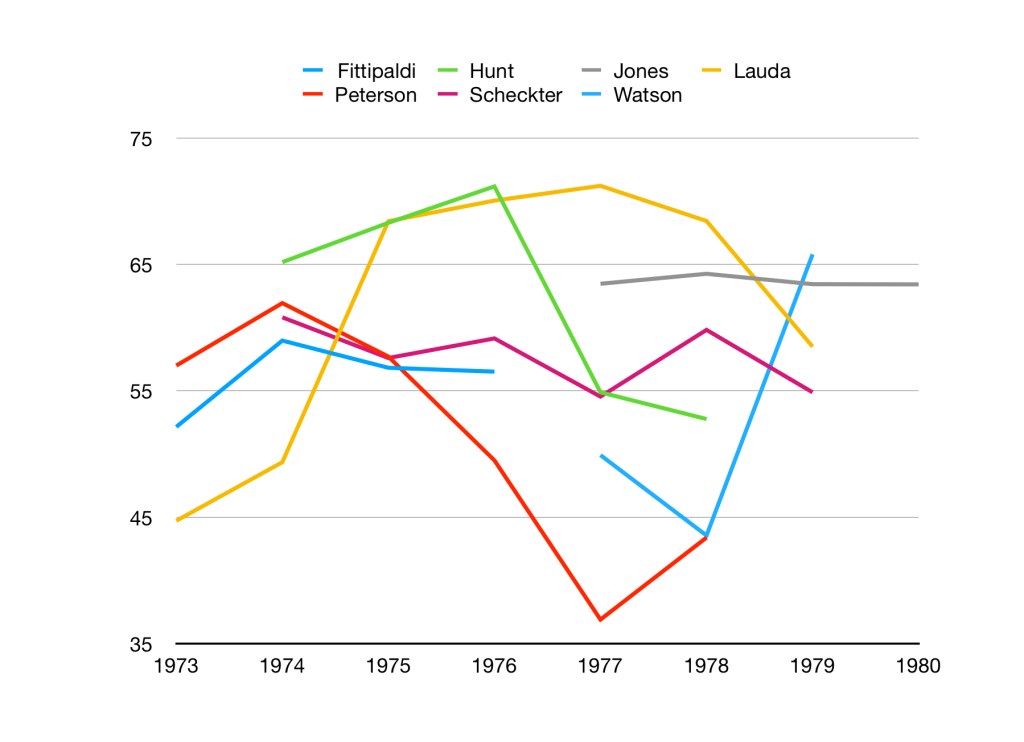
Lauda‘s 1st career follows a traditional more pronounced arc than most. There’s a significant improvement in his first couple of years before peaking and seeing a gradual decline. He is considered to be a stronger driver whilst in a better car, and is probably the best driver of the era overall.
Hunt is a worthy rival to Lauda, although, as previously discussed, his career has a lack of teammates of known quality. He was also one of the most crash prone drivers of the era,. Finally, he suffered a dip in form after winning the championship in 1976 before taking a relatively early retirement.
Although his peaks are not as high as Lauda’s or Clarks, Jody Scheckter is seen as a consistent driver. His championship year of 1979 is not seen as one of his strongest seasons. The highest rated driver of 1979 is John Watson. Alan Jones is also seen as strong in this era. However, both are at a lower level than the drivers of the early 80s.
1980-1986
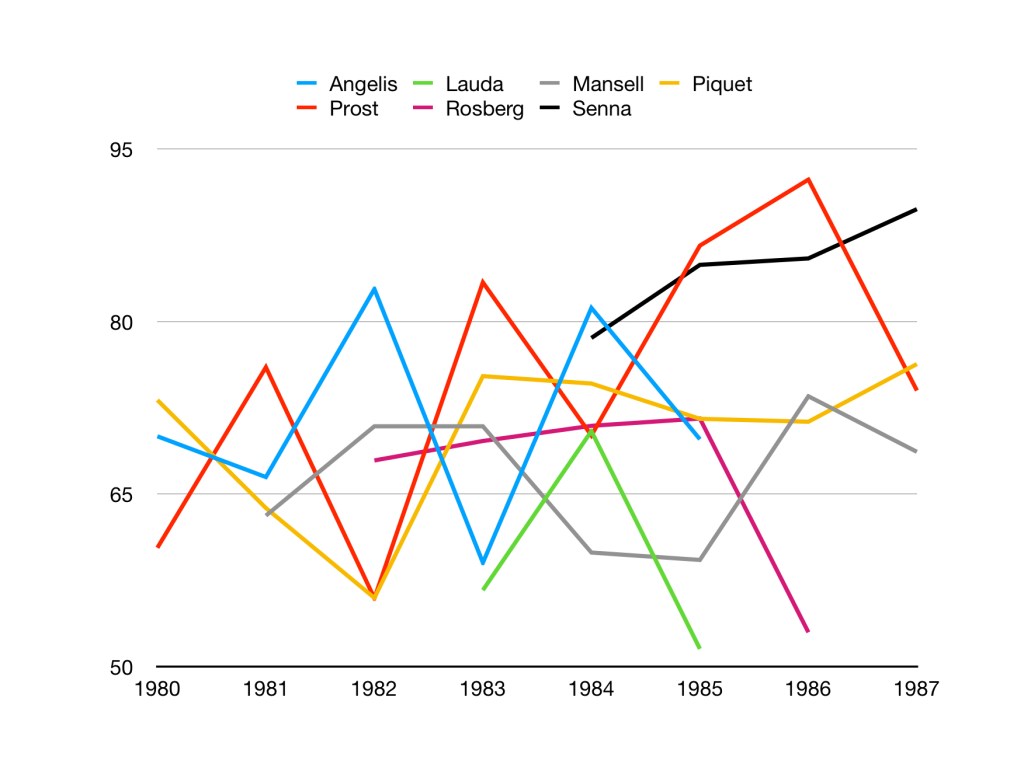
In just his 2nd season, Prost was the highest ranked driver. Unlike most drivers, the inclusion of DNFs has done little to improve his consistency, which still varies significantly year-to-year in his early career. This leads to a lot of overlap in season ratings with other top drivers of the era. However, by the mid-late 1980s Prost reached new heights at McLaren. His 1986 season set a new record for highest rated season, finally beating that set by Fangio in 1954.
de Angelis is once again considered to be strong contender for best driver of the early 1980s. The model considers him to be roughly Prost’s equal at the time, although the quality of his machinery varies massively year-to-year. (It’s hard to assess his 1983 season, for instance, due an abysmal finishing rate of 13%.) His fatal testing crash in 1986 prevented him from achieving more in the sport. He’s the highest ranked driver of both 1982 and 1984.
Senna was an incredibly strongly rated rookie in 1984, and continued to progress thereafter. His 1985 and 1986 seasons were two of the highest rated seasons ever at the time. However, he is denied a top ranking in both years by even better ratings by Prost.
Other 80s F1 Drivers
Piquet is rated the strongest driver of 1980. He’s then consistently in the top 4 drivers for the rest of the decade, but with lower peaks than Prost, Senna of de Angelis. Keke Rosberg also had some strong years during this era. Interestingly for both of these drivers there is little correlation between higher yearly ratings and championship success. The same cannot be said for Lauda, whose comeback very much peaked in his championship year of 1984. Mansell also produced some strong seasons in the 1980s, with championship challenges in 1986 and 1987 amongst his best.
1987-1993
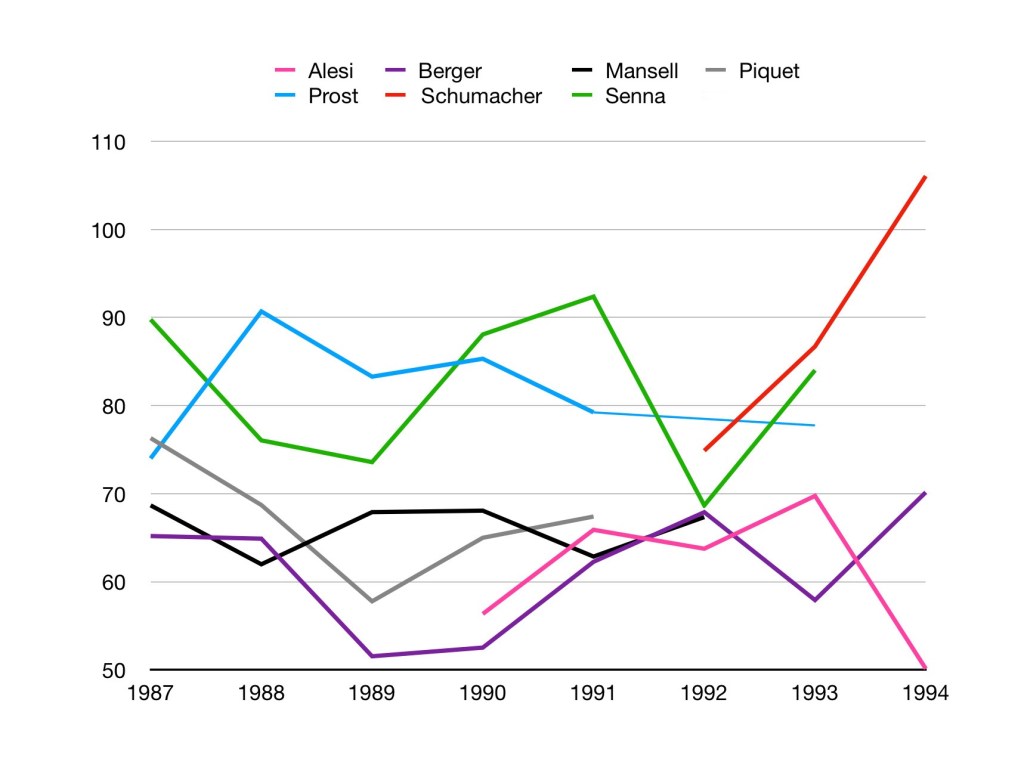
Prost and Senna were closely matched in the late 1980s and early 1990s. Prost is ranked as the stronger McLaren driver in both their years as teammates, due to all rounds being counted by the model. During the early 90s Senna’s ratings improved whilst Prost’s declined slightly. The model previously gave a clear edge to Prost when comparing the pair, and I would argue that this conclusion is still valid now. However, the gap between them has significantly narrowed, and cases could be made for either driver. (In qualifying Senna of course had a major advantage).
For example, there is some evidence that Prost was better than others at keeping his car in one piece. If this is true then the inclusion of DNFs would unfairly hurt him slightly relative to others. However, the model uses all race results, which helps Prost relative to Senna. Other factors such as a perceived bias against Senna by the FIA or wet weather pace will of course affect people’s opinions too.
Other Drivers
Mansell and Piquet continued to show themselves to be strong drivers. Mansell’s 1992 season saw a (then) record 9 victories. Whilst the model considers it to be an above average season for him, it is still not rated as his best season overall.
Berger and Alesi are also considered to be somewhat competitive during this era. The pair formed one of the closest driver pairings of the 1990s.
At the end of this era Schumacher emerged as a top driver. He’s rated as the top driver in 1992 and 1993. However, his ratings for both of these seasons are below the top ratings of Senna and Prost in previous years. Alesi was previously seen as a contender for top driver in 1992, but his rating has decreased due to the unreliability of his Ferrari car (particularly in his teammate’s hands). Meanwhile, Schumacher’s unreliability in 1993 boosted his ranking ahead of Senna’s.
1994-1999
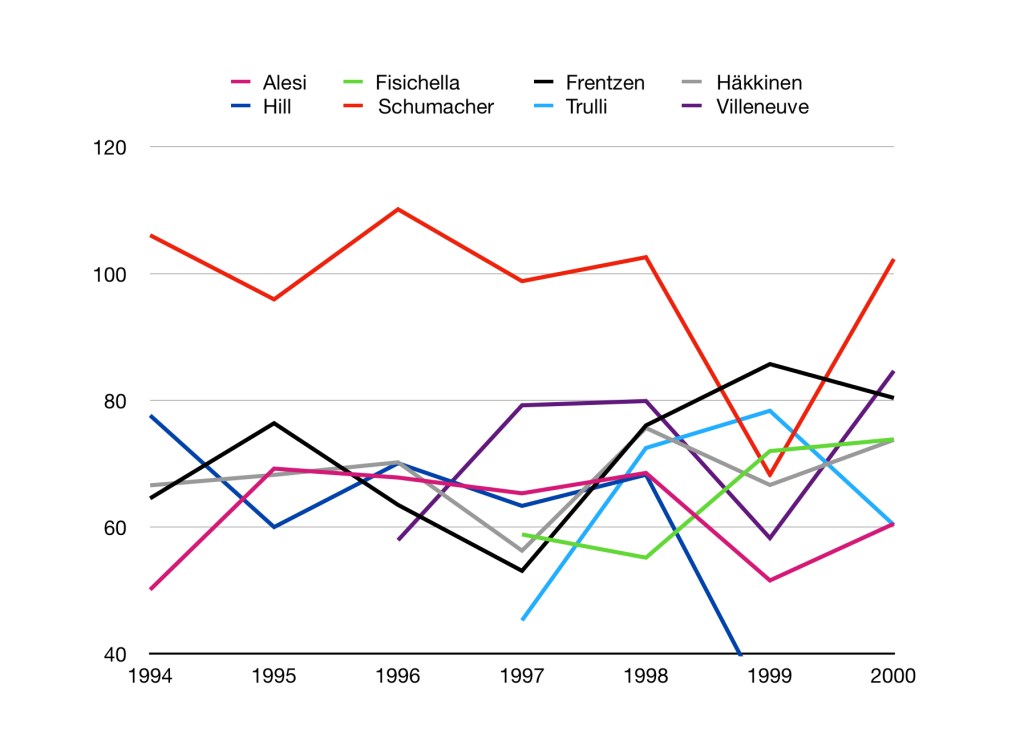
It will come as no surprise to see that Schumacher still absolutely dominant in the mid-late 90s. This is true of both the model’s rankings and the general impression of drivers from the era. His 1996 season was one of the weakest in terms of results (with just 3 wins in his first Ferrari season). However, it’s considered his strongest season of this ever, as well as the strongest season ever at the time.
Behind him we see a large number of very closely ranked drivers such as Alesi, Hill, Hakkinen and Frentzen. Frentzen’s peak season was in Schumacher’s major dip in 1999, allowing him to secure a year as the best performer. (Schumacher missed half the season due to injury.)
In the late 90s, Villeneuve was also consistently ranked among the highest (non-Schumacher) drivers. Newcomers Trulli and Fisichella showed potential in their early years in the late 1990s. However, their ratings were subsequently overtaken by a new, stronger generation of drivers in the early 2000s.
2000-2006
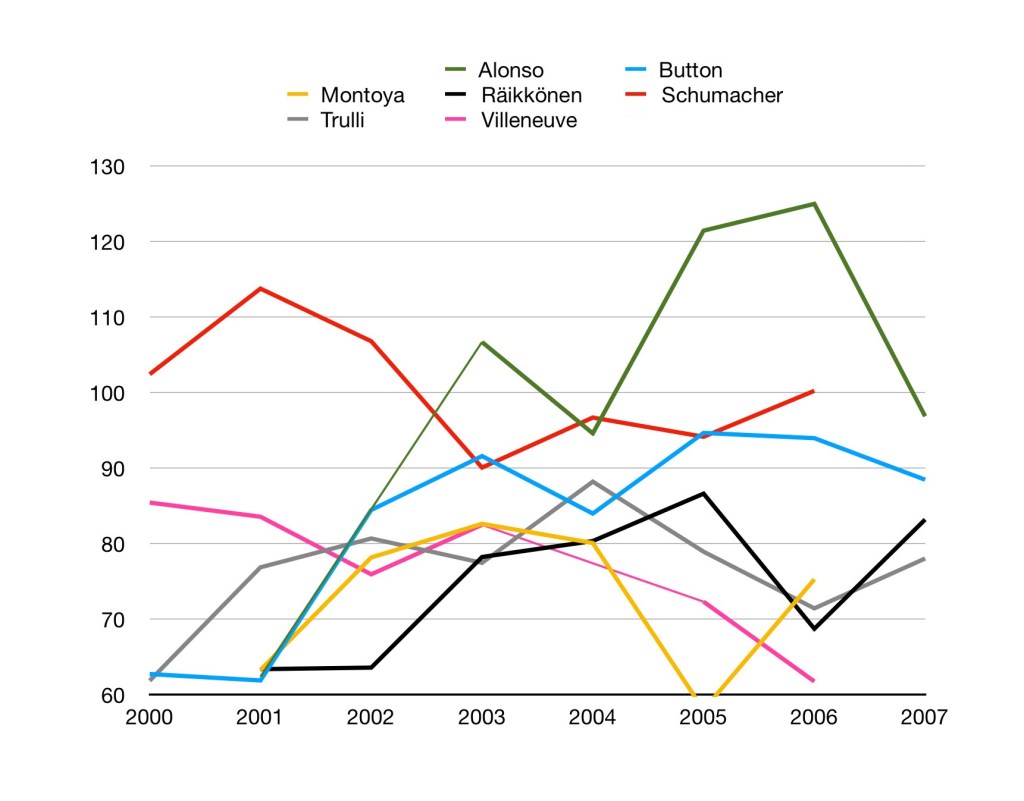
Schumacher continued to dominate the early 2000s. His 2001 season is seen as his absolute best, whilst 2002 was seen as his last truly great year. By comparison, the years 2003-2006 (which include 2 driver’s championships) are merely considered to be extremely good. One significant change from the previous model is that Schumacher is now ranked the best driver in 2004. This is partly due to a slight lowering of Alonso’s ranking for the year.
However, Alonso still emerges as a top performer in the mid 2000s. His championship years set new standards, and were not beaten by another driver until the 2020s.
Behind Alonso and Schumacher, Button is considered the 3rd best driver overall after a couple of learning years in the sport. From 2003 onwards he had the edge over teammates Villeneuve and Barrichello, and flattened teammate Sato.
Fans often rate Raikkonen highly, especially during his McLaren years. During this era, he’s seen as a strong driver, but not the strongest. Some people have been surprised that correcting for DNFs has not significantly improved his overall ranking. However, the criteria for an improved ranking is not “suffered several DNFs”, but “suffered significantly more than their teammate”.
Other drivers that had at least 1 very strong year in this era include Trulli , Montoya and even Villeneuve, despite his lack of success after leaving Williams in 1998.
2007-2013
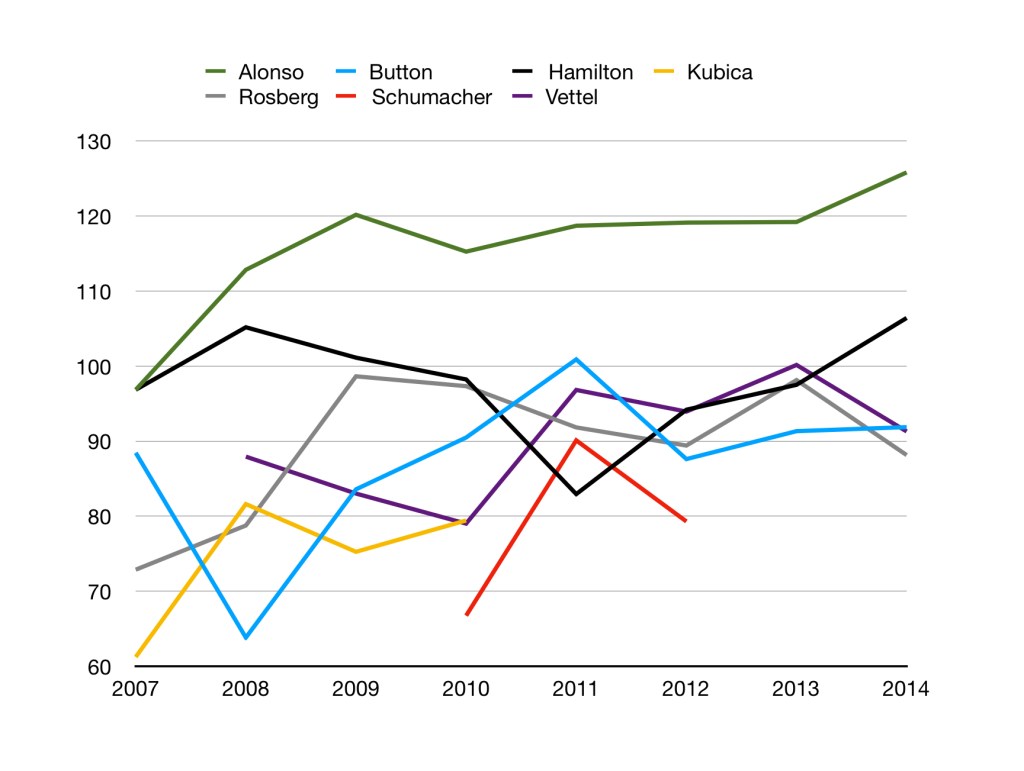
Alonso is considered to be the best driver of this era once again. He dominated teammates Piquet, Grosjean, Massa and Raikkonen. Whilst 2012 is often cited as Alonso’s zenith, the model sees his Ferrari era as fairly consistently strong year-to-year.
Hamilton is the highest rated driver of 2007, which is incredible considering it was his debut. (This has only been achieved one other time- Verstappen in 2015). For the next 3 seasons Hamilton was rated as 2nd best, behind Alonso. His performances versus Kovalainen (2008-2009) were impressive. However, Button (2010-2012) and Rosberg (2013-2016) were both closer to Hamilton than expected, despite a pace advantage both times in Hamilton’s favour.
The most successful driver across this era was of course Vettel. As previously, the model thinks that he was not as strong as Alonso (or even Hamilton) across this era as a whole, but still ranks him strongly. He’s considered the 2nd best driver in his dominant 2011 and 2013 seasons.
Other Drivers
Rosberg is also a strong driver during this era. His success versus Schumacher is considered impressive, even accounting for Schumacher’s age and lack of experience in 2010. During this era, he has the 4th most impressive results overall. However, he’s considered an absolute top-tier top qualifier.
Button‘s peak in 2011 is considered higher than anything Rosberg or Vettel achieved, but his overall level is slightly lower. His 2009 championship is not considered to an exceptional year by his standards, although it is rated higher than his championship rivals Barrichello, Webber and Vettel.
Kubica‘s ratings from 2008-2010 are considered to be good, but not quite on the level of a top driver. The model rates Schumacher‘s 2010 season relatively poorly, but is more buoyant about this subsequent years. Finally, Raikkonen is considered to be a decent but not exceptional driver during this era. He’s the 4th highest ranked driver in 2007, but is never rated this highly again amongst increasingly impressive competition.
2014-2018
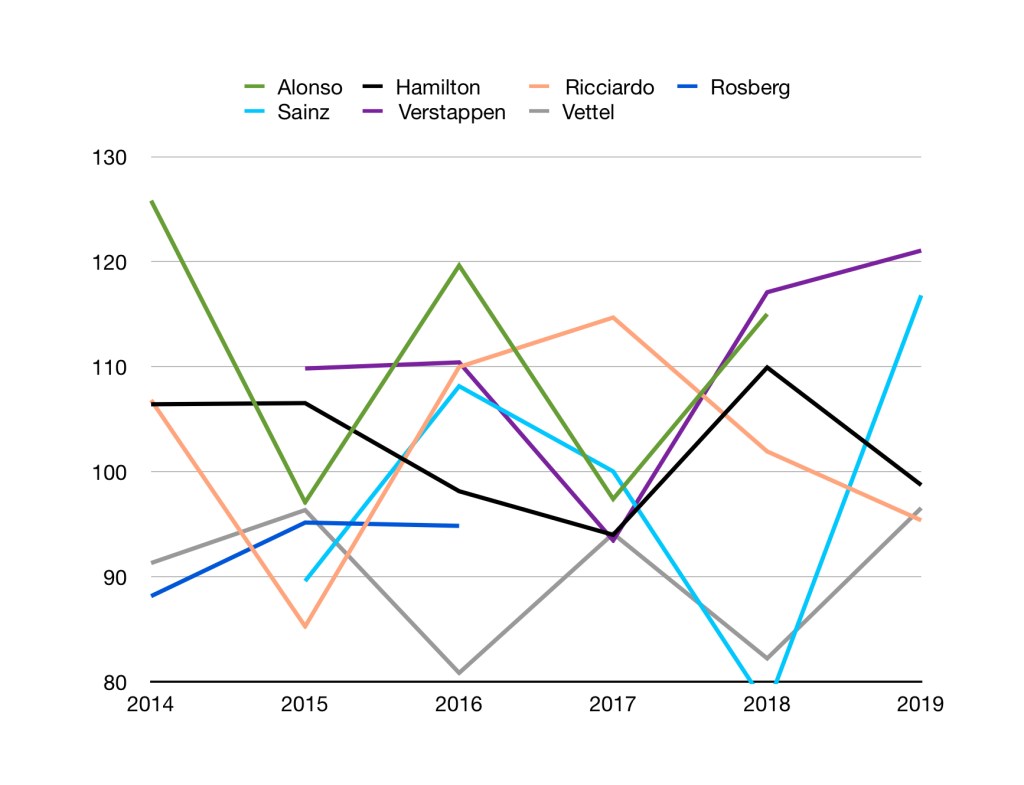
This period sees a transition between Alonso and Verstappen for the position of top rated driver. Alonso‘s disastrous McLaren-Honda stint caused his previously consistency in ratings to go out the window. Alonso’s last great season is 2014, which is followed by a bumpy decline. (The model still considers him to be well above average.)
During this era Verstappen established himself as one of the top drivers on the grid. However, subsequent performances suggest that he only reached close to his peak at the end of the 2010s.
Another extremely capable driver in this era is Ricciardo. He outscored elite teammates Vettel and Verstappen in 2014 and 2017 respectively. Meanwhile, his 2015 season is seen as less disappointing once reliability is accounted for. He is rated as the best performing driver in 2017, due to outscoring Verstappen in the same car despite worse reliability.
Other Drivers
One talking point about the early hybrid era is whether Vettel‘s form dropped off, and at what date the decline began. The model does not see any major indication of this across these years (although 2020-2022 is a different story). For example his performance in 2018 is below average, but not dramatically so. However, new talent such as Verstappen, Ricciardo and Sainz mean that the model does not consider him to be an absolute top line driver during this era.
Finally, Rosberg is rated below Hamilton in each of his final 3 seasons. He’s the only world champion of the 21st century who is ranked outside the top 5 in that season. However, he’s considered a relatively strong performer roughly on the level of Vettel.
2019-2023
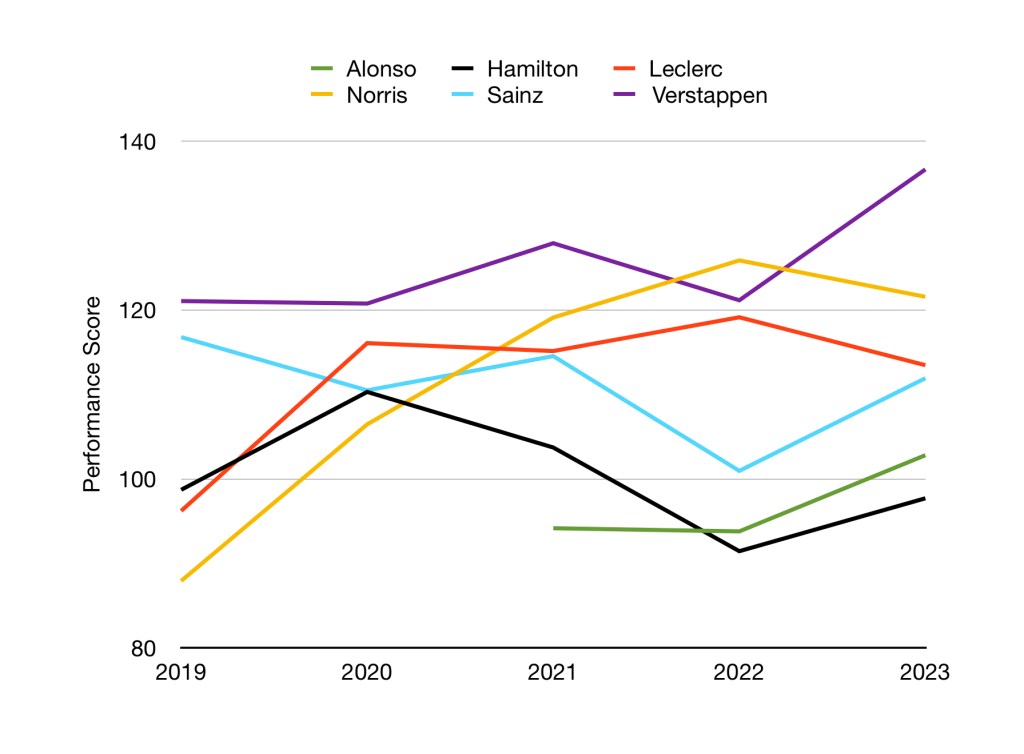
Verstappen has continued to establish himself as the greatest driver of his generation in the model’s eyes. After Ricciardo left Red Bull, Max has had no sustained competition within the team. Whilst it could be argued that he’s never gone up against a generational talent, Gasly, Albon and Perez are all more than capable drivers that he’s dominated. His 2023 season was ranked as the highest of all time. However, his 2024 season looks even better.
Leclerc is still considered to be a very strong driver, almost at Verstappen’s level (although always slightly adrift). However, Sainz‘s rating has gradually increased, due to both impressive performances vs Leclerc and an improved rating of Norris.
Norris and Leclerc have both spent significant amounts of time in F1 as teammates to Sainz, meaning that their ratings are all closely linked. Their times outside of being Sainz’s teammate have also featured extremely poor performances from high profile teammates. (Leclerc vs Vettel in 2020 and Norris vs Ricciardo in 2022.) To see how much these results affect their rankings overall, we can try to discard those specific matchups from the model. This does cause their ratings to drop, but not by much. Rather than being rated the 2nd and 3rd best drivers on the grid, Leclerc and Norris are instead in contention for the titles of 2nd and 3rd best drivers. Thankfully Sainz and Leclerc will face new teammates in 2025. This will allow the model to quickly adjust if they are indeed currently overrated.
Other Drivers
Hamilton is still seen to be performing at a strong level. However the model predicts that Leclerc is likely to come out on top at Ferrari next year, particularly in qualifying.
Alonso’s performances post comeback are considered to be good, but not really comparable to his earlier career at Renault and Ferrari. Russell‘s performances have also been relatively strong over the past couple of years, and it will be interesting to see how he develops at Mercedes in a (probable) team leader role.
2022-2024
The best ranked driver of 2022 is Norris after his flattening of Ricciardo. Verstappen’s dominant 2023 season saw him set a new record for a highest ranked season. The results for the 2024 season will be published soon, as the season is not complete at the time of writing they are not included here.
The Best F1 Drivers Each Year
This table lists the highest ranked driver of each year, and makes comparisons with that years world champion.
[table id=7 /]Drivers With The Most “Top Performances”
[table id=8 /]Summary of Eras
| Time Period | Top Driver(s) | Next Best Drivers |
|---|---|---|
| 1950-1957 | Fangio/Ascari | Gonzalez |
| 1958-1962 | Moss | Brabham/Ireland |
| 1963-1967 | Clark | Gurney/Surtees |
| 1968-1972 | Stewart | Peterson/Fittipaldi/Ickx |
| 1973-1979 | Lauda/Hunt | Scheckter/Jones/Watson |
| 1980-1984 | Prost/de Angelis | Piquet/Mansell |
| 1985-1992 | Prost/Senna | Piquet/Mansell |
| 1993-2002 | Schumacher | Villeneuve/Frentzen/Hakkinen/Hill/Alesi |
| 2003-2006 | Alonso | Schumacher/Button |
| 2007-2014 | Alonso | Hamilton/Button/Rosberg/Vettel |
| 2015-2018 | Alonso/Verstappen | Ricciardo/Hamilton/Sainz |
| 2019-2024 | Verstappen | Leclerc/Norris |
Performances of Driver’s Champions
The championship winner is, in general, ranked highly. They’re rated the top driver nearly half the time, and over 3/4 of the time they’re in the top 3.
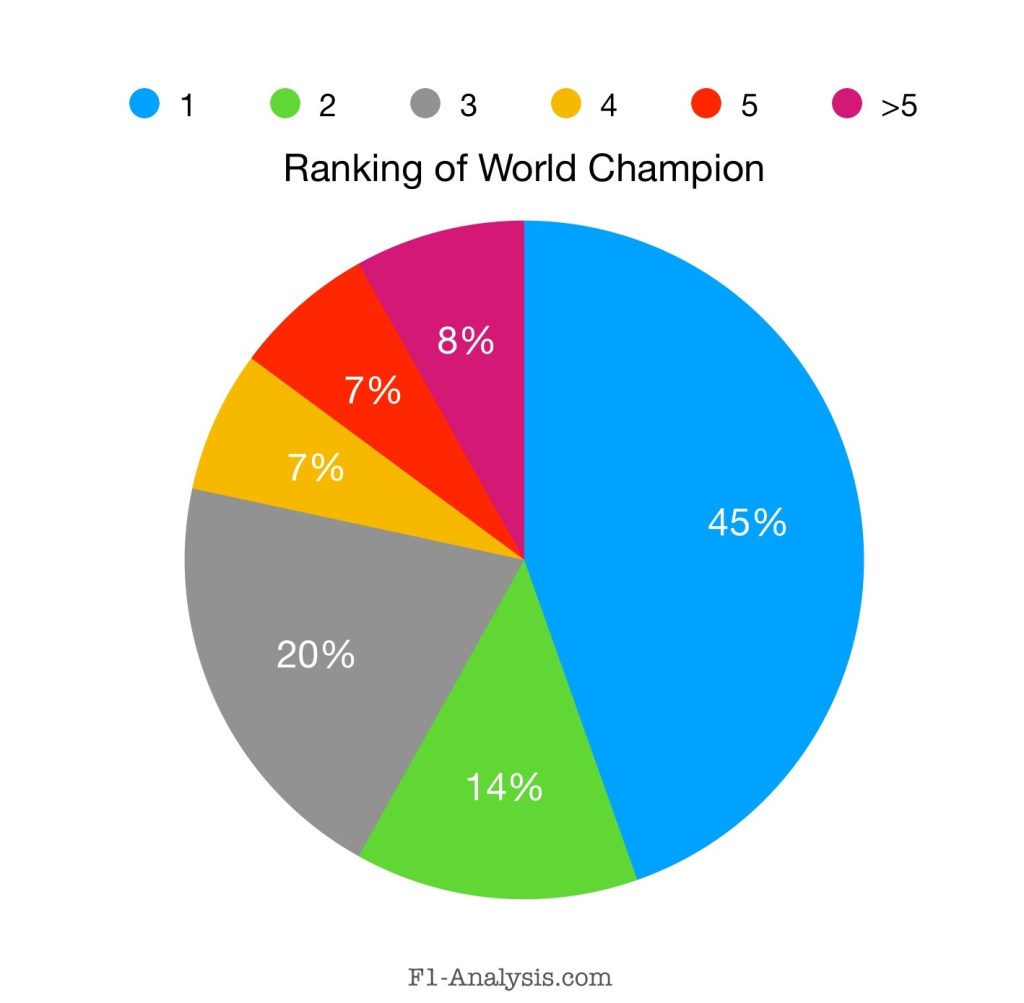
On only 6 occasions was the world champion not in the top 5 ranked drivers. However, this has only occurred twice since 1980: Rosberg 2016 (6th), Häkkinen 1999 (7th). On both occasions the drivers were at the lower end of a cluster of closely ranked drivers. The lowest ranked championship winner in Phil Hill, in 13th place for the 1961 season.
However, we must always remember that even the “worst” F1 world champions were still performing to an extremely high level. F1 has always been a rather exclusive sport, after all.
Please subscribe to get email notifications of when new articles appear! (My schedule is rather scatty. Subscribing will mean you won’t miss anything.)
I’ll be posting a ranking of every driver for the 2024 season a few days after the final race, along with some posts on key stats for the 2024 season.
Thanks for reading! Please let me know what you think of the model and the results.
 F1 Analysis