Happy 2026 everybody! Similar to last year and previously, I’m using the mathematical model to make predictions on the driver lineups for the 2026 F1 season. Last year the model’s predictions were largely correct, and I’m hoping for even better this year too!
If you enjoy my content, please consider subscribing to know when new articles hit. Anyway, let’s get started.
- Challengers for 2026
- F1 Driver Predictions 2026
- McLaren: Norris vs Piastri
- Mercedes: Russell vs Antonelli
- Red Bull: Verstappen vs Hadjar
- Ferrari: Leclerc vs Hamilton
- Williams: Sainz vs Albon
- Racing Bulls: Lawson vs Lindbald
- Aston Martin: Alonso vs Stroll
- Haas: Bearman vs Ocon
- Audi: Hulkenberg vs Bortoleto
- Alpine: Gasly vs Colapinto
- Cadillac: Perez vs Bottas
- Pairing Drivers For The Model
- Conclusions
Challengers for 2026
Predicting outcomes for seasons is always tricky. Drivers have stronger and weaker years, and the reasons for this are sometimes unknowable. And whilst luck does tend to balance out over a season, it’s not always the case. However, there are a few unique challenges involved for the predictions of how drivers will compare in 2026.
1) A New Competitive Order
To model will predict different percentages for driver pairings depending on how competitive the car is. For simplicity’s sake, I assume the car’s level is constant year-to-year when making the percentage points predictions. Given the new regulations and the potential jumbling of the competitive order, this assumption may be less accurate than usual.
2) Drivers “Suited To” New Rules
The model assumes that a driver’s “base level’ is consistent year-to-year. There are adjustments for inexperience and old age, but that’s it. However there’s often discussion on how the characteristics of cars or tyres suit certain drivers or styles. This opens up the possibility that some drivers may do better/worse simply based on whether the new cars suit them.
Personally I think the idea that rule changes cause wild swings in a driver’s level is overblown. However, that doesn’t mean a driver’s exact competitiveness in a new rule set will be identical to the one before.
3) Unpredictable Rookie Progress
All 2025 rookie drivers are expected to improve in 2026. This seems pretty reasonable. But the model also assumes that each rookie will improve by the same amount… which seems more questionable. This is basically just a lack of data. Last year the model wasn’t able to make any reasonable prediction for the rookies. This year it can, but the predictions are a little more shaky than for more experiences drivers.
Looking at years gone by, some rookie drivers (e.g. Hamilton) hit the ground running straight from the off. Other drivers (e.g. Piastri) improve by more than the model predicts when they gain experience. The reasons for this are always nuanced. (One thing to bear in mind is it’s not well correlated with a driver’s ultimate potential. Anyway, on to the predictions!
F1 Driver Predictions 2026
McLaren: Norris vs Piastri
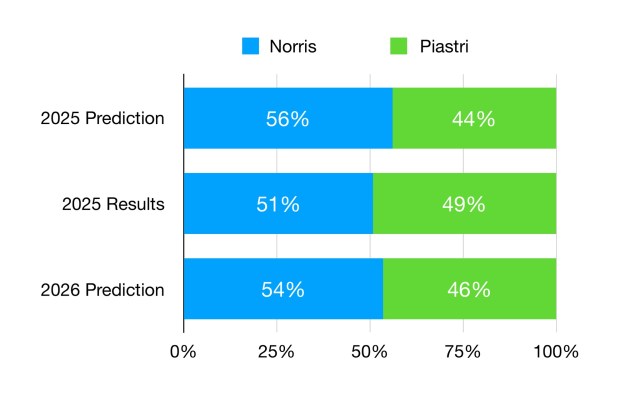
With 3 seasons under his belt, Piastri’s lack of experience is not a major factor anymore. Meanwhile Norris’ 2025 season was seen as slightly disappointing, despite being ranked the 3rd best driver and winning the championship. As such, the model predicts a slightly larger gap between the McLaren drivers. The difference seems small, but it would be enough to diffuse the intra-team 2025 title battle before the finale.
As referenced above, Piastri has thus far always over delivered as he’s gained experience. It remains to be seen if 2025 was a peak performance or just the continuation of his progress.
Mercedes: Russell vs Antonelli
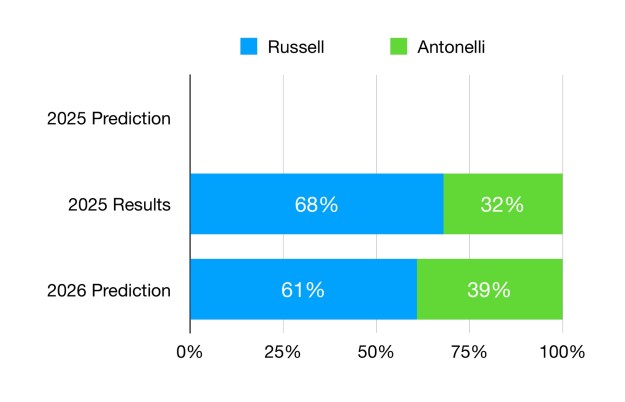
Mercedes will expect more consistency from Antonelli in his second year. Indeed, it’s highly likely he will be more competitive relative to Russell across the season. However the model still puts Russell as the heavy favourite in this match-up.
Red Bull: Verstappen vs Hadjar
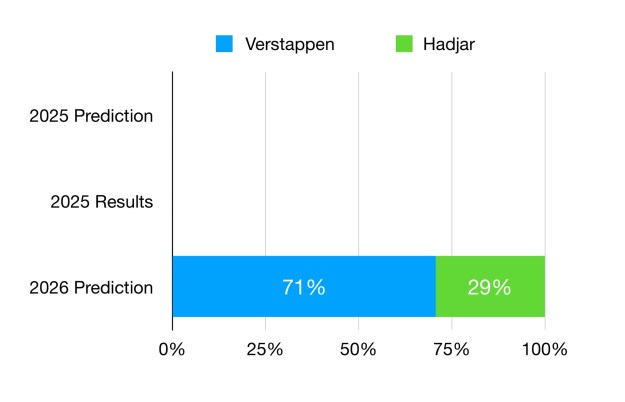
Once again this is predicted to be the most one sided match-up. The prediction is also more extreme than the one proposed for Verstappen vs Lawson at the start of 2025. (Although both come from fairly limited data.)
29% of Red Bull’s points may seem paltry for Hadjar, but it would actually be a solid return. If Verstappen’s hit rate is the same as in 2025, this would give Hadjar around 175 points. That translates to regular points finishes and probably multiple podiums, something Tsunoda never looked close at replicating. Given the circumstances, this seems like an ambitious but not ridiculous target.
Ferrari: Leclerc vs Hamilton
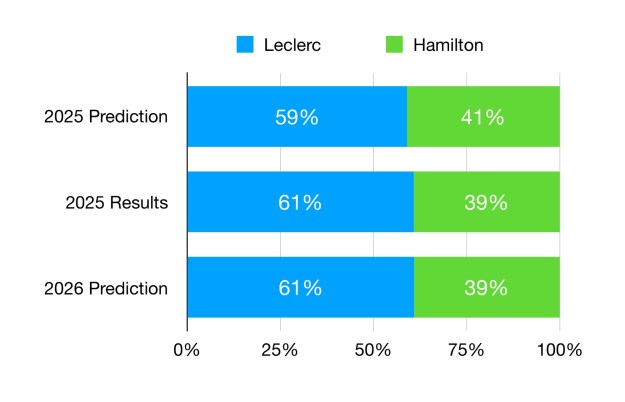
The model sees no reason for a significant change in the teammate match-up at Ferrari. Given Hamilton’s year was slightly disappointing, he is likely to come back stronger in 2026. However, he’s also a year older, which the model factors in.
As usual, the model also expects the gap to narrow if the car is more competitive. Given Ferrari’s 2025 struggles, this is distinctly possible.
Williams: Sainz vs Albon
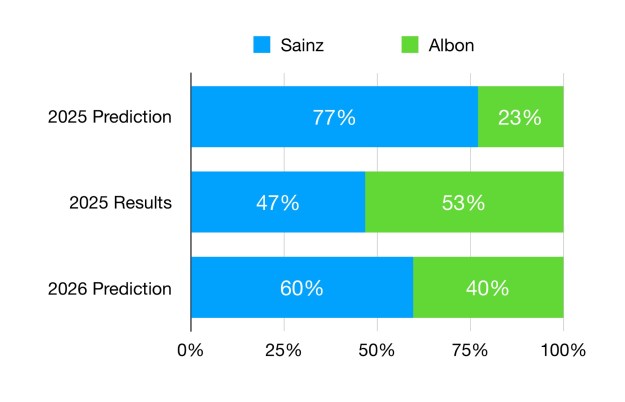
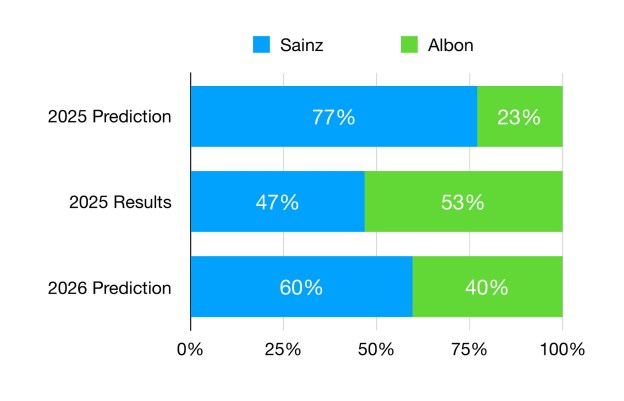
The model still gives a significant advantage to Sainz, although less so than last year. This is partly a reflection on Albon’s points victory over Sainz in 2025. It’s also a reflection of the car being more competitive. (Remember, percentage points generally narrow as car competitiveness improves.) The swing in performance across 2025 at Williams was a great narrative from last year. It’ll be interesting to see if Albon can regain some momentum within the team.
Racing Bulls: Lawson vs Lindbald
Given Lindbald is a rookie driver, there’s no data to make a formal prediction. However, Hadjar managed to outscore Lawson in 2025 despite being a rookie. A repeat for Lindbald would be very much the target. On the other hand, a drubbing by Lawson probably being terminal for his long-term career prospects.
Aston Martin: Alonso vs Stroll
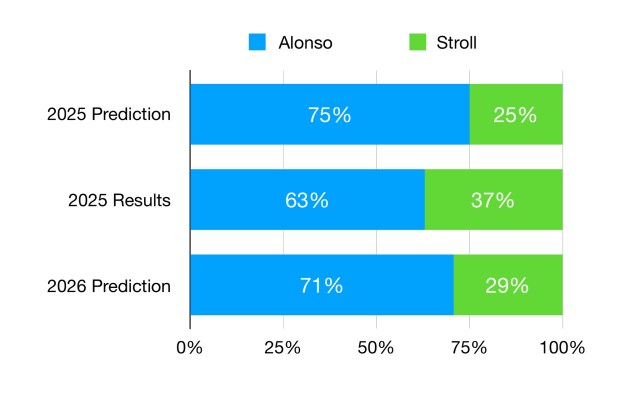
Alonso’s comeback as a whole has been seen as a little disappointing by the model. (This is more of a reflection of how highly the model rated his 1st career than anything else.)
Despite this and being another year older, the model still believes Alonso will lead the way. Expectations are big at Aston Martin, despite a disappointing opening few days. As with Ferrari, expect this percentage gap to narrow if the car is competitive.
Haas: Bearman vs Ocon
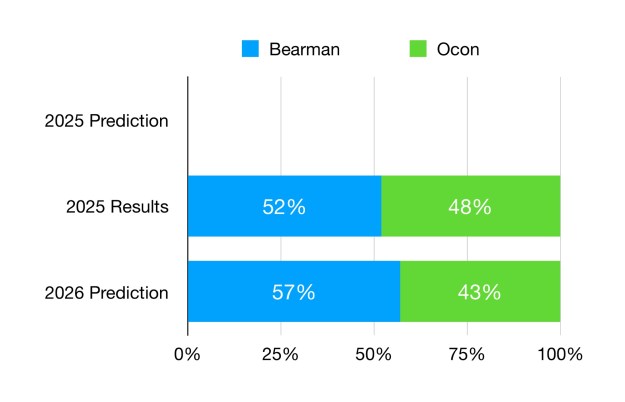
Bearman was the standout rookie of 2025 in the model’s eyes. A further inching ahead of Ocon is therefore considered to be the most likely state of things in 2026.
Audi: Hulkenberg vs Bortoleto
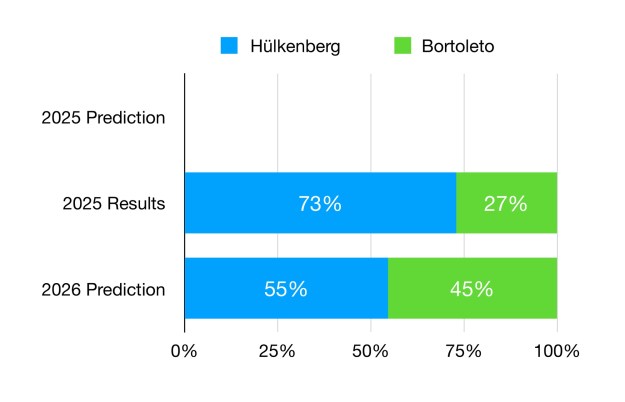
Hulkenberg is unsurprisingly still considered the lead driver at Audi, but the gap is predicted to close considerably. This is partly due to the natural improvements of a rookie driver, but age is also a factor. Whilst Hulkengerg is practically a baby compared to Alonso, he still turns 39 this year. The model therefore believes his absolute peak years are probably behind him.
Alpine: Gasly vs Colapinto
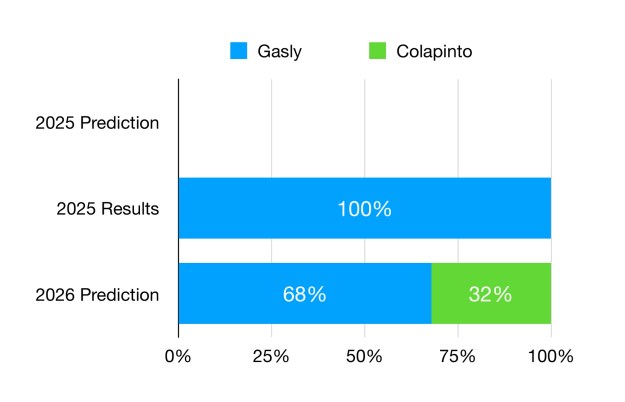
There’s not a massive about of data to go on due to Alpine’s awful 2025 contender. With a years experience and pre-season testing for the first time, Colapinto should come back stronger. The prediction of 32% would have translated to just 10 points in 2025. (A small number, but a huge leap from his actual 0.) Alpine will surely be hoping for more points from both their drivers this year.
Cadillac: Perez vs Bottas
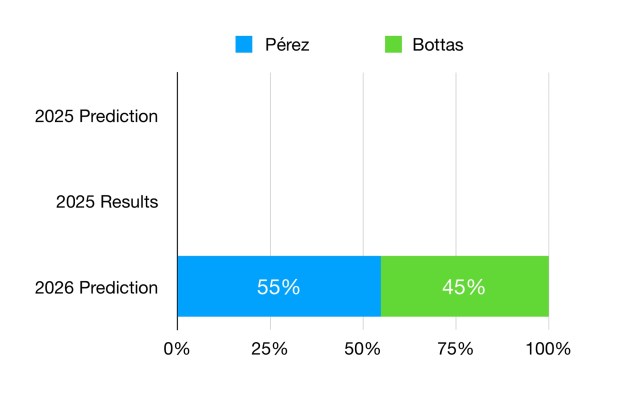
Given this is a brand new team, my system of using last years competitiveness as a basis for this year’s prediction goes out of the window. Instead, I’ve assumed the lead driver will score 40 points. (As the percentages are close, they actually don’t vary too much with different competitiveness.)
A line-up of two race winners is impressive for a new team. It’s reminiscent of the Trulli-Kovalainen line-up of the Caterham team. However, the team surely has more long term potential.
The prediction that Perez will outscore Bottas is linked to how the model views their previous teammates. Most obviously, Verstappen and Hamilton. As such, I thought it’d be worth going on a tangent to see why direct link between Perez and Bottas drivers is helpful for the model as a whole.
Pairing Drivers For The Model
Perez vs Bottas is of course an interesting line-up to compare by itself. However, it also provides some cross-pollination between a Red Bull and a non-Red Bull driver.
The model is able to link almost every driver in the history of F1. However some are much more closely linked than others. When delving into the pairings of current drivers, a clear trend emerges: the strong linking of Red Bull drivers to each other. Meanwhile, non-Red Bull drivers often fall into 2 camps. Some are still tied to Red Bull in the model’s eyes. Others are almost completely separate. Here’s a summary of how the model sees the 2025 and 2026 F1 drivers:
| “Red Bull Drivers” | Notable red bull ties | no significant red bull ties |
|---|---|---|
| Verstappen | Perez | Hamilton |
| Hadjar | Leclerc | Alonso |
| Lindblad | Ocon | Stroll |
| Lawson | Hulkenberg | Russell |
| Sainz | Bortoleto | Bottas |
| Norris | Bearman | |
| Piastri | ||
| Albon | ||
| Gasly | ||
| Colapinto | ||
| Tsunoda | ||
| Doohan |
The first striking thing is just how many drivers are considered to be “Red Bull drivers”. For anyone confused, let’s look at Piastri as an example. His only teammate thus far has been Norris, and Norris’ only other teammates were Sainz and Ricciardo. This means that both drivers have got their ratings directly by comparisons with Red Bull drivers.
Note the model doesn’t have a formal distinction here, it’s just about how much driver’s ratings influence each other. What this means is that if Bottas thrashed Perez, it would likely lead to an increase in the ratings of all “non-Red Bull” drivers. It may also lead to a decrease in Verstappen’s rating which would then spill over into other Red Bull drivers. (I should note though, that black-and-white analysis like this doesn’t always translate into reality. It would obviously depend on other team results too.)
One interesting addition is that several experienced drivers who didn’t race in 2025 actually reinforce this idea. For example, Massa partnered Bottas and Alonso for several years, but no Red Bull drivers. Raikkonen, Button, Rosberg, Magnussen and Grosjean are also clustered on the non-Red Bull end. They often partnered each other or other non-Red Bull drivers.
Ricciardo and Kvyat are good examples of the opposite of this. Almost of their teammates were Red Bull drivers. And even in cases where drivers “escaped” Red Bull, it doesn’t always lead to significant cross-pollination. For example, Ricciardo left and then returned to partner Red Bull drivers. And Sainz and Albon have still ended up together.
What about Vettel? Surprisingly he is not considered to be part of the Red Bull driver cluster! His Toro Rosso teammates have no link to future Toro Rosso/Red Bull drivers. (This is due to the internal structure of the Red Bull Young Driver Program.) There’s also no external Red Bull link from Webber. Only a single year against Ricciardo links Vettel to future Red Bull drivers in any way.
Conclusions
As always we’ll check back on these predictions at the end of the year.
| Team | predicted lead driver | predicted 2nd driver |
|---|---|---|
| McLaren | Norris | Piastri |
| Mercedes | Russell | Antonelli |
| Red Bull | Verstappen | Hadjar |
| Ferrari | Leclerc | Hamilton |
| Williams | Sainz | Albon |
| Racings Bulls | N/A | N/A |
| Aston Martin | Alonso | Stroll |
| Haas | Bearman | Ocon |
| Audi | Hulkenberg | Bortoleto |
| Alpine | Gasly | Colapinto |
| Cadillac | Perez | Bottas |
Thanks for reading! I’m looking forward to the end of the year to see how everything sorted itself out.
 F1 Analysis
It’s hard not to agree with all of these. Maybe Bortoleto has a chance against Hulkenberg, tho, if he brings some brains to his speed.
LikeLiked by 1 person
Pingback: F1-Analysis.com | F1 Analysis
I’m surprised how conservative the prediction is for the McLaren drivers, given how Norris and Piastri fared against each other last year. Piastri has three seasons on his resume, so I still see for him a room to grow, while Norris is, more or less, a finished product.
LikeLike
Norris’ slump in the first half of last year was a clear underperformance though; his execution (i.e., Saudi, Bahrain, etc) was just bad, and he clearly threw away points (i.e., Canada, Baku) across the races. These predictions tend to assume that both drivers are at their best, and Norris last year clearly wasn’t at his best.
LikeLike
Norris’ slump in the first half of last year was a clear underperformance though; his execution (i.e., Saudi, Bahrain, etc) was just bad, and he clearly threw away points (i.e., Canada, Baku) across the races. These predictions tend to assume that both drivers are at their best, and Norris last year clearly wasn’t at his best.
LikeLike
Rather than assuming they’re at they’re best, the predictions assume a typical season for the driver given their age and experience.
However, your general point is correct. 2025 is seen a slightly weaker than expected year for Norris, and the model assumes a return to the mean.
LikeLike
Pingback: Do New F1 Regulations Change The Competitive Order? | F1 Analysis