The 2011 Canadian Grand Prix has gone down in legend. Lasting over four hours, it was the longest F1 race of all time, with almost half the race run under safety car conditions. More bizzare still, eventual winner Jenson Button went through the pits six times (including a drive through), had two separate collisions that eliminated rivals and was plum last with 40/70 laps completed.
Most of the focus on the race is on the length of the race and Button’s various incidents. However, here we will look Button’s recovery drive. This portion featured one safety car (during which there were no significant pit-stops) and a fairly routine switch from intermediate to dry tyres. So how did Button manage to clear all 20 cars ahead of him in just 30 laps?
- Phase 1: Wet Tyres on Drying Track
- Phase 2: Button’s Slick Tyre Masterclass
- The Final Phase: Button’s Unlikely Victory
- Conclusion
Let’s split this final stage into 3 phases and take each in turn:
- Wet tyres on drying track (laps 40-50ish)
- The switch to slicks and subsequent safety car (laps 50-60)
- The late push on slick tyres (laps 61-70)
Phase 1: Wet Tyres on Drying Track
After colliding with Alonso on lap 37, Button crawled back the pits. Luckily for him Alonso’s beached car meant the safety car was deployed. This allowed Button to (almost) catch the back of the pack again before the race restarts. From there, he steadily made progress through the field, picking off cars one by one. In this phase he was aided by a few factors:
1) F1 2011 Field Spread
The slowest time in Q1 at least year’s Canadian Grand Prix (2025) was just over 8 tenths off the fastest time. This would have been good enough for 7th in 2011! Indeed, at the time several backmarkers were 4+ seconds a lap off the pace in standard dry conditions. These cars were therefore easy pickings for Button in a way that would not be possible today.
2) DRS
A few laps after the safety car came in, DRS (drag reduction system) was enabled. As a default the system was disabled when the track was wet, so the race director’s decision to allow it was a major boon to Button’s progress.
One interesting side note is that several drivers (including Button) either forgot they had DRS, or didn’t activate it correctly at one time or another throughout the race. The system was new for 2011, and even by the mid-season not every team/driver had developed a good protocol for consistent activation.
3) Mixed Condition Errors
Several drivers ahead made errors in the conditions, which gave Button some free overtakes. However, not everything was going Button’s way in the wet conditions. These included the Force India drivers, and Felipe Massa a little later in the race (discussed below).
Limitations to Progress in the Wet
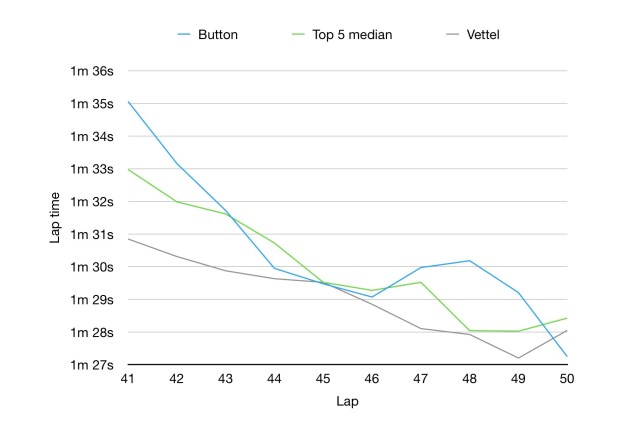
One thing that may have hampered his progress was the drying line, which made off-line overtakes increasingly tricky. Another potential issue in the chase for victory was his time deficit. Whilst Button’s pace was generally competitive through the wet tyre phase, he was consistently losing time to leader Vettel. At the end of the wet tyre phase of the race, Button was running in 9th place and had lost 15s to Vettel in the previous 9 laps. This is not unusual given he he was making his way through the field, but it did mean that a victory still looked highly unlikely at this point in time.
Phase 2: Button’s Slick Tyre Masterclass
Button has become infamous as the driver who knew what to do in slippery wet conditions. Either knowing when he pit for slicks (Australia 2010) or knowing when to stay out on slicks (Hungary 2011 and Brazil 2012).
However, four other drivers pitted on the same lap as him in Canada 2011, with five others pitting at least a lap before. Despite being out of position and potentially benefiting more from a risky strategy, his timing was completely average. (Most of the lead drivers did indeed transition to slicks a little later. This is expected due to there being less risk involved in a later stop. McLaren actually believed their chosen lap was going to be aggressive, only for Webber to go first.
Despite the average timing, this phase of the race was completely transformative for Button. Once on slicks, he was much faster than anyone else.
This fact is evidence towards the idea that Button’s incredible condition predicting powers are something of a myth. His main strength is being to generate and maintain heat in the tyres under damp conditions. This not only makes him faster than most in damp conditions, it also gives him a significantly larger window when slick tyres are appropriate. It’s this ability that made him able to “predict” the switch earlier; he was just more likely to stay on track and lap competitively than other drivers.
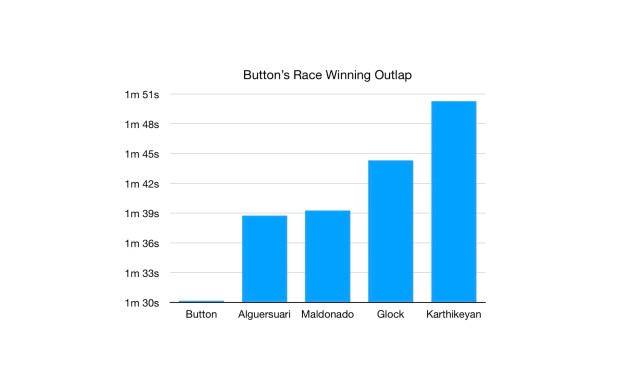
Let’s look at at his outlap on slicks, compared to the 4 other drivers that pitted on the same lap. Whilst the competitiveness of the cars is varies, keep in mind that Button was racing both Maldonado and Alguersuari at this phase of the race.
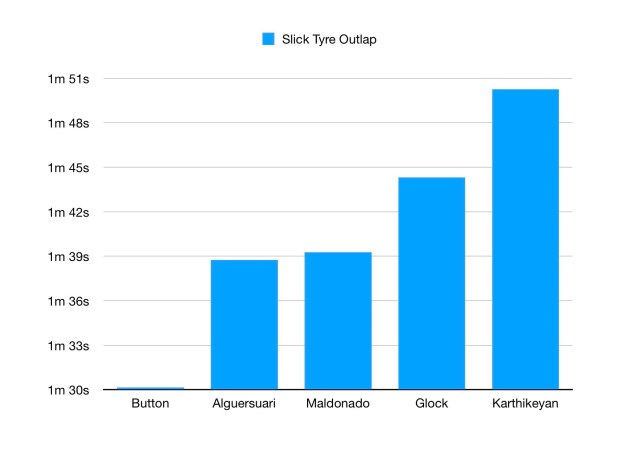
In case you missed it, Button’s outlap was ASTOUNDING. Whilst everyone else was sliding around trying to heat their tyres, Button was lapping almost 9s faster then the fastest other driver who pitted that lap. Not the first time, a crucial outlap on slicks made the difference. Within just a couple of laps he was up to 4th, and a podium looked on the cards.
But let’s see if this outlap was just as impressive when compared the the leaders he was now competing against:
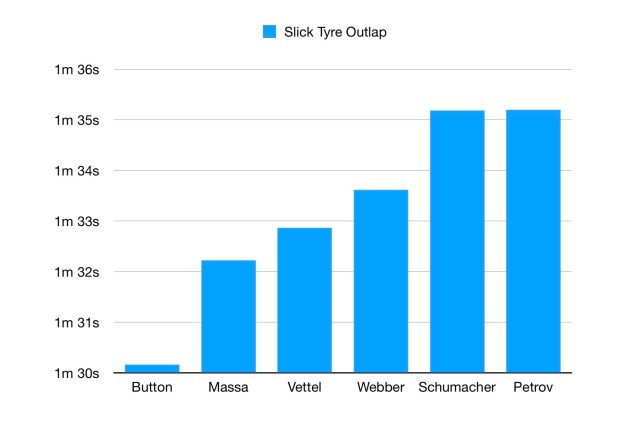
Whilst the gap’s are not as extreme, you can see that Button’s outlap was still extremely impressive. There are even a couple of caveats that work in Button’s favour. Firstly, all of these drivers stopped later than Button except for Webber. This may have artificially narrowed this outlap gap as the other drivers had both more information and a drier track. It also meant that Button gained on them even more than suggested here, as he had an extra lap (or 2 in Vettel’s case) on slicks, which was fundamentally the faster tyre. Finally, Massa had the “advantage” of having two consecutive outlaps, after crashing into the wall after veering onto a damp patch trying to avoid a backmarker.
A look at how the times evolved lap-by-lap for the leaders is shown below.
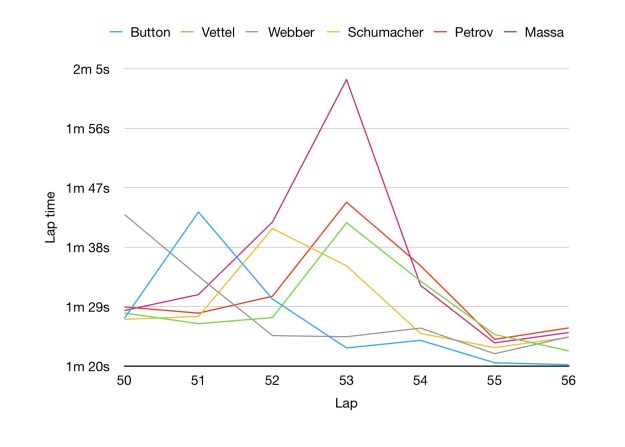
It’s clear that Button was on a charge as soon as he got the slick tyres on. For the first time, he was rapidly reeling in Webber, Schumacher and Vettel ahead of him.
Then came yet another safety car.
The Final Phase: Button’s Unlikely Victory
The good news for Button is that this final safety car allowed him to eliminate the remaining gap to the cars in front. Indeed, overall the safety car was (once again) a sprinkling of luck for Button in this race. But it wasn’t all good news. There was a backmarker between himself and Webber, making a restart overtake impossible. The safety car had robbed him of laps when his pace was so good. Webber in front would be difficult to pass as both he and Button would have DRS. There was no guarantee that Button’s previous pace advantage would return.
Of course we now know that Button’s relative pace did not suffer from the safety car. Whilst he lost several laps clearing Webber and Schumacher ahead, he was once again easily the fastest driver whilst free.
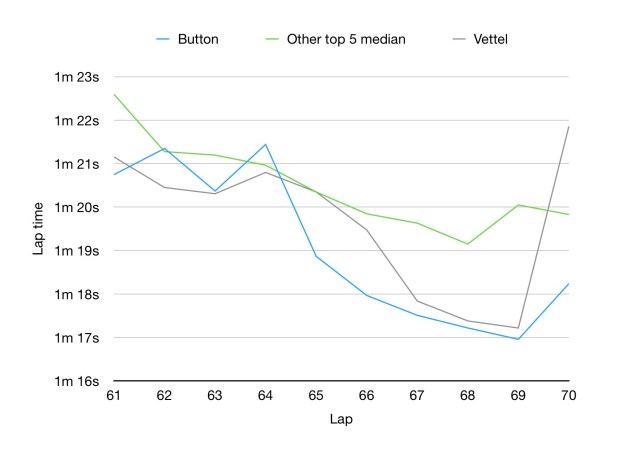
From there he caught the back of Vettel, and pressurised him into making a small but costly error on the final lap.
What could Red Bull/Vettel have done differently?
Firstly, it’s important to emphasise that Vettel had an exceptional race overall. Had Button been eliminated in his clash with Hamilton or Alonso, the race would perhaps be rememberd as one of Vettel’s greatest. He was faster than every other driver for almost the entire race. He was also almost flawless and controlled the multiple safety car restarts well.
One thing that is clear from Vettel’s lap times is that he had plenty in hand after the safety car restart. Vettel’s pace increased by 3s over the first 3 laps Button broke free into second. Had he been lapping at this kind of pace straight at the restart, there’s no chance Button would have been able to close the gap. So was Vettel too conservative across laps 61-65?
Maybe.
It’s easy to reach this conclusion in hindsight, but Vettel was still lapping faster than any other driver at this point. He was also still on slick tyres on a damp track (particularly offline), so the costs of small mistakes were likely to be larger. It’s notable that his final ceding of the lead to Button was not due to a lack of pace, but rather due to a small mistake… and pushing harder in the earlier laps also would have increased the chance of mistakes. He would have looked very silly indeed if he’d pulled away at 2s a lap after the safety car only to put it in the wall. Vettel knew he had more pace in the car, so why risk using it earlier when it might not even be necessary?
Overall, Red Bull were fairly conservative with Vettel across the whole race. This was entirely logical and had served them well. For example, they were one of the last to pit for slicks. The late pit-stop to slicks was theoretically costly given the slicks for around 5s a lap faster (once heated up), but the later safety care nullified any time lost anyway. The only long-term consequence of the late stop was slightly fresher tyres for the final stint.
Ultimately, it’s all very well to say that Vettel should have “just” pulled a bigger gap on Button whilst the Brit was busy fighting for second. Or that Vettel shouldn’t have “choked” on the final lap. But hindsight is 20/20, and Vettel’s performance up to the final lap was far more consistent than Button’s, who made several significantly mistakes across the race.
Conclusion
-Button’s victory owed a LOT to luck. He survived 2 collisions that wiped out the other drivers, and the various pitstops left him last but still in the race. The multiple safety cars and red flag also assisted him overall.
-His pace in the final wet stages was good enough for solid points, and he duly climbed the order. However he was losing significant time to Vettel ahead.
-Button’s timing of the pit to slicks was average. However, his pace on slicks was sensational. These few laps put him into 4th place.
-A final safety car had some drawbacks, but overall benifitted Button by eliminating the deficit to Vettel ahead.
-Vettel probably had the pace to keep Button at bay, but a small error let him through.
Please subscribe for more articles.

